Sunday, June 18, 2023

Wall by Jen Craig

“This novel gives the reader one of the best depictions of thinking in fiction that I have read in a long time” – Talking Big

"... combines exactitude and vagueness, immediacy and distance, to approximate how scatty, worm-like human thought might be represented on the page" – The Saturday Paper

“the skeletal frames of [Craig’s] narrative plots are barely visible beneath the roving stream of consciousness that encases them” – Sydney Review of Books

"Craig’s work constructs an idiosyncratic monologue …. that traces the thoughts of a London-based artist whose father, a hoarder, has died in Sydney" – Sydney Morning Herald


Such appreciations of Jen Craig's third novel testify to a distinctive remove from the default facility of the anglophone novel, with an incremental intensification of the narrative form taken in Since the Accident and Panthers and the Museum of Fire. However, I'm doubtful of the reviews' characterisation of Wall as a relocation of thought from mind to page, not only because the novel is presented as a letter, but also because it ignores the tension generated by inheritance that constitutes the novel in its basic plot content: between daughter and parents, anorexia and hoarding, the artist and the art world, and its form: the inheritance from literature, in which thought is already writing.

The reviews also testify to their own concern for inheritance. While the foreground purpose of comparing Jen Craig's prose style to that of David Foster Wallace, Henry James, Samuel Beckett, William Gaddis, Gerald Murnane, László Krasznahorkai, Jon Fosse and Mathias Énard and, most commonly, WG Sebald, who voiced his own anxiety about literary inheritance, is to situate an author in a market bustling with reading choices, the background noise, made clear in the excess of the list, is anxiety about the value and meaning of art going forward, perhaps in the hope that the future of the novel lies in its past. It's no coincidence that a similar anxiety generates the narration of Wall. The purpose of the letter is to announce that its writer, an installation artist, has given up on making a version of Song Dong's installation (about hoarding) which had promised art-world success and thereby relief from the impossibility of completing an original installation (about anorexia) in recognition that, rather than in opposition, one is the correlate of the other. Without explicit awareness, we realise we are reading in a space outside of such possibility and impossibility; a space set aside from the ambition and despair, from success and failure, from value and meaning, from going forward; a space often shared by Thomas Bernhard's narrators, such as the two brothers in On the Ortler, recently translated in The Rest is Slander, which also takes the form of a letter. While the names listed are valid comparisons, this may be Wall's most significant inheritance, one in which the will contains the unthinkable.

Monday, May 15, 2023

Literature likes to hide

Last December I was fortunate enough to borrow a copy of The Unmediated Vision, Geoffrey Hartman's first book, published in 1954. It is difficult to find a copy now but you can download a digital version of the book via the link. The opening chapter is a 50-page study of "Tintern Abbey" in the context of Wordsworth's work as a whole, focusing on the comparative simplicity of its language and imagery, and the problem of the agency of poet's imagination in the presence of the trees, rocks, rivers and waterfalls of the Wye Valley. He says Wordsworth strove "toward the expression of a mystic feeling...that no amount of thought can explain, and no feature of these objects considered in themselves can justify".

I was very moved by the essay, not least because, in addition to a close reading of the poetry, Hartman is deeply aware of the philosophical and cosmological tradition in which the poet worked. I realised that Nature as it was experienced in the time of the Romantics has certain parallels to my experience of literature in this unnamable time: the apprehension of something that is intimately our own and yet from which we are set apart. "The general body of Wordsworth's imagery" Hartman summarises "may be related to the idea of an inland ocean partially ebbed from the face of the earth, but visible in the distance, and audible everywhere—even to the top of the mountains."

What do we see and hear from the literature of our time? Everything, it seems, but a sense of that which enables and that which impends. Or should that be the literary criticism of our time?

Thursday, April 20, 2023

Atheism of the novel

"Here it comes: the information dumping..."

From section 237, page 185 of Ellis Sharp's latest novel, the part that is commentary on his attempt to write a commercially successful novel emulating "the style that The Guardian liked and promoted":

The narrator is a young woman, a publicist for a London publishing house. Her name is Jane Tain. She is trying to solve the mystery of her father's death. In the course of achieving her goal she falls in love and finds happiness which had eluded her father. The story ends on an uplifting note. The writer imagined seeing it in paperback, with a bright cheerful cover and a multiplicity of praise from the reviewers of the corporate press. [...] The novel was called The Professor's Wife.

And this is the novel we read when not interrupted by the writer's contempt for the "dull, attention seeking prose", for the back stories and the layers of characterisation he has written, for what he feels is the dishonesty of the whole enterprise. He picks up another novel, Peter Handke's The Afternoon of a Writer, which he'd seen recommended online, and discovers this is the kind of prose he wishes to read: "It has honesty." But rather than destroy The Professor's Wife completely, he disfigures its sentences. 

The car drove past and [deleted].
My heart beat wildly at what I'd just witnessed. Was this [deleted].

Curiously, in spite the writer's vandalism, we follow Jane Tain's quest with interest, relishing along the way her caricatures of the contemporary literary scene: the zombie series author pandering to an audience of "fifteen-year-olds with spots", the literary enfant terrible "McCartney" who combines "experimental physics and Joyce's modernism" and the columnist Bryony Flappe whose fans are "either ardent young fogeys in tweeds, with a penchant for luminous yellow ties, or elderly, angry men with florid cheeks and check shirts". The missing words not only fail to get in the way but somehow enhance our anticipation of a revelation, thus reviving the drowned dog of the title. As Jane points out when a friend fails to notice a discrepancy in the evidence of her father's final journey: "It's the dog," I said. "The dog that didn't bark in the night, or however it goes. Look at what isn't there." 

Does this mean that, despite the writer's contempt for his efforts and horror at what gets celebrated around the country, even the most cynical, button-pressing novel partakes of something that always isn't there? We might see this as the persistence of the life of the novel despite the insistent herald of its death, much as the assertion of the death of God is the persistence of religious energies in an otherwise entirely secular culture. 

What isn't there in The Professor's Wife is Jane's father, which enables her to discover the truth of his life. The father's death is the tain of her story, necessary for her presence just as the dark backing of a mirror is necessary for our presence before it, albeit in the inevitable dishonesty of a reversed image.  

Month of a Drowned Dog ends with the birth of the writer's daughter, an uplifting note apparently apart from The Professor's Wife, apparently resisting the darkness of the tain. She reaches out to hold the writer's little finger: "The grip is surprisingly strong" he says, leaving readers unsure whether this loosens or strengthens the grip of what isn't there.


In 2015, I wrote about Ellis Sharp's novel Lamees Najim, which in this case begins with the birth of a baby.

Saturday, December 24, 2022

The Opposite Direction, a book

Please use a link below to download an ebook of posts selected from over the last seven years of this blog. 

This is the second collection after This Space of Writing and the title comes from the adolescent Thomas Bernhard's phrase repeated to an official at the labour exchange as he resisted the best options for his future; self-sabotage as a career move. 

Some comments from readers of the first book:

Mitchelmore writes at a level unparalleled, in my opinion, and is one of the most acute thinkers about which books and writers really deserve our fullest attention and why. He has made me a much better reader.
              Terry Pitts, Vertigo blog 

[He] is particularly attuned to the form, the feel and the voice of a piece of writing … and that the sum of all these encounters makes his own writing here as tremulously alive and clear as so many of the works he writes about.
              Jen Craig, author of Panthers and the Museum of Fire


Reading him, one senses an engagement and curiosity that aren’t primarily motivated by passing judgement. Rather, he sees literature as a living encounter in which something is at stake for both writer and reader. 
              Alexander Carnera in Le Monde Diplomatique

He writes with an intensity of focus that either sucks you in or makes you scornful.
              Robert Minto, writer and critic


EPUB                                   PDF


For the record, I did contact two small presses that I admire about publishing it as a real book, but one had too much on already and the other didn't reply, so I gave up; self-sabotage as a publishing move.

If you do read the book, I'd be grateful if you post a response or a link to a response either in an email or in the comments section below. Comments are moderated to resist spam so will appear after a short delay and, barring abuse, I will allow every one through, even if your name is Claire Lowdon.

Monday, December 12, 2022

Favourite books 2022

This selection does not include those books I enjoyed, that asinine dilution poured into innumerable books of the year lists, though I enjoyed those not included in this selection.

Jon Fosse – Septology

Thomas Bernhard – The Rest is Slander

"we are concealing a secret, a secret of which the Englishman is incessantly speaking, a secret that is actually directly opposed to what he supposes it to be." 

Marjorie Perloff – Infrathin: An Experiment in Micropoetics

'The “auditory imagination,” let’s recall, is defined by Eliot as “the feeling for syllable and rhythm, penetrating far below the conscious levels of thought and feeling, invigorating every word.” One cannot prove that Eliot consciously chose to produce the dense verbal-sonic-visual structure I have been describing, but the drafts suggest that in fact he did revise words and phrases in the interest of sonic and visual density as well as semantic subtlety.'

Giorgio Agamben – When the House Burns Down

"Reflection – the 'I think' – is … the point where the speaker who is about to discover himself unwillingly to be witness and poet finds a mirror in which to escape solitude, a last refuge from which he can still somehow offer meaningful discourse and propositions. We all cling to an 'I' in order to escape from the solitary encounter with language, in order not to be constrained to poetry. This is the meaning of Hölderlin's stubborn critique of reflection..."

And, unexpectedly, three books on the Bible:

Avivah Gottlieb ZornbergThe Beginning of Desire: Reflections on Genesis 

'The "rebellion" of the generation around the Flood can be understood as a failure to speak, to communicate with God – or, indeed, with each other. There is a pathology is the very "openness" of the Flood generation which converts openness to a dumbness, a dumbness of the babble rather than of silence.'

Gabriel Josipovici – The Book of God: A Response to the Bible

"The man in the field [Genesis 37: 15-17] and the young man in the sindōn [Mark 14: 51-52] stand for the primacy of narrative over interpretation. How they came to be there will never be known. That they are there cannot be gainsaid. To interpret them away, to provide explanations as to why they are there, is to do away with the whole Joseph story, the whole Passion narrative, and, in the wake of this, with the whole of Genesis, the whole of Mark, the whole Bible – and, in the end, with the whole of literature."

Massimo Recalcati The Night in Gethsemane: On Solitude and Betrayal

“From Jesus’ perspective, there is, in effect, no possible truth without its testimony. That means that the truth of the Word consists in its incarnation alone. It’s the radical ethical hermeneutics of Christianity: the letter without testimony is a dead letter; without heart—without desire—the meaning of the Law can’t be understood.”

Monday, November 14, 2022

The Lascaux Notebooks by Jean-Luc Champerret

Lascaux, a placename standing for the abyssal revelation of the cave paintings discovered there after millennia in darkness, and Notebooks, suggesting a private endeavour, preparation, a work to come. While neither is secret as such, neither was meant for the light. Two intrigues then for the price of one. 

Of the notebooks, Philip Terry explains that he was offered a dusty crate found in a chateau under renovation that contained the disintegrating papers of an obscure French poet who had scouted the Lascaux caves as a possible hideout for his wartime Resistance cell in which he worked as a codebreaker (a cell that included “a tall wiry Irishman”). The poems found among the papers are Terry's translations from the French of Champerret's translation into contemporary poetic forms of the signs and symbols painted or carved alongside the famous paintings of animals. 

According to The First Signs by the paleoarchaeologist Genevieve von Petzinger, there has been little attention given to the meaning and significance of the signs and, while she doesn't offer a translation herself, she does say they could be humanity's first writing system. This gives retrospective mitigation to Champerret and he uses the freedom to gradually augment their spartan form to create the atmospherics of a domestic Ice Age scene. There are numerous others: descriptions of mountainous landscapes, the killing and butchery of prey, burial rituals, and ceremonies performed by shaman. As the poems follow the seventy signs listed in the back of the collection, the vocabulary is limited and over 380 pages this can be a monotonous read, enlivened by occasional use of prose and the patterning Mallarmé used in Un coup de dés. Even so, in the movement of each poem we sense from a state of deathless being in the world to one of displacement and distance – storytelling – stimulating in the reader an awareness of the profoundest moment in human evolution, which one cannot say of most other books of poetry.

"Movement" and "evolution" may be deceptive words here because everything changed as the first sign was simultaneously carved and read. A space opened in that instant, differing from the animal paintings because they are recognisable as representations of animals, whereas what the signs represent retreats behind their appearance, opening a beyond to their purely communicative value. Yes, the scholars say that the signs must have meant something to those who created them except, in such an act, a world apart was exposed. This is the great secret of the signs; an open secret which nevertheless remains.

What is also an open secret is that there was no Jean-Luc Champerret, no crate of papers, no poems in French. It’s curious then that of the four reviews of that I’ve found of The Lascaux Notebooks only one of them is aware that the author and his poems are inventions. Despite this, two reviewers take on face value Terry’s origin story, which one might think too literary to be true, with the hint of Champerret's connection to Beckett removing the benefit of the doubt. Of course, one cannot expect a reviewer to know an author's previous publications but one might hope they would look up Terry's name and discover that he edited The Penguin Book of Oulipo as well as works by the most renowned Oulipean of all, if not also notice that the blurb for his 2021 novel Bone announces that it was written without “letters with descenders (g, j, p, q, y)”. This prison narrative is in the spirit of the linguistic exercises by which the uninvented Dr Edith Bone maintained her sanity while solitary confinement for seven years; a literary embodiment of the prison-house of language and the unexpected spaces confinement might open, marvellously independent of authorial intention, all of which may have led reviewers to hear the echo of “Sham Perec” in Jean-Luc’s surname. [Update: I now understand one of the reviews didn't mention it in order not to spoil the effect.]

Missing this is perhaps an insignificant detail, a mere point of order, as is the fact that the story of the discovery of the Lascaux cave is itself an invention. Melvyn Bragg's introduction to the recent BBC's In Our Time episode on cave art repeats it and goes uncorrected by his expert guests. In a lecture in 1955, Georges Bataille tells his audience that the story of a dog called Robot falling down a hole and whose rescue led to the discovery was either made up by a journalist or local gossip and that the true story is that a storm uprooted a pine tree and a woman decided to put her dead donkey in the hole that had opened up, telling a local boy she thought it may be the entrance to a tunnel rumoured to lead to a château. Later, the boy and a couple of wartime refugees decided to explore the hole when some other refugees they had arranged to meet in order to give them "a good thrashing" failed to appear. 

As I wrote, perhaps insignificant. But at the end of the In Our Time episode, one expert says there is still lots of learn about cave art and while "we're still in the dark to some extent" recent developments in radiocarbon dating and dendrochronology should help to illuminate what's left to learn. For the ancient people, descent into the Stygian darkness of the caves is where they discovered, invented, themselves, and us. Philip Terry's transformation of the signs into poetry and dissimulating its origin may in turn be the proper means to turn our eyes towards that darkness. As Bataille writes elsewhere in a book of poetry and in opposition to poetry:

Poetry was simply a detour: through it I escaped the world of discourse, which had become the natural world for me; with poetry I entered a kind of grave where the infinity of the possible was born from the death of the logical world.

As it is, we're still in the light.

Wednesday, October 19, 2022

The criticism of Lessons, the lessons of criticism

I give thanks to Ryan Ruby for his review of Lessons, Ian McEwan’s latest novel. It brings to our attention that rare thing, joy of joys, a novel telling the story of a life remarkably similar to the author’s own set against the backdrop of recent history. Ruby shows how the novel is the inevitable conclusion of a path he has followed for many years as, in all but two novels McEwan has produced since The Innocent in 1990, the “subject matter has been ripped from the headlines”:

As befits a regular of the international festival circuit with the occasional byline in the Guardian opinion page, [McEwan’s] treatment of issues such as the Iraq War, climate change, euthanasia, artificial intelligence and Brexit could be described as narrativized punditry.

In the hope of killing off the genre, the final two words should enter the critical lexicon alongside James Wood’s “hysterical realism”. Both are symptoms of the loss of confidence in the novel as an art form, as something in itself, something apart. Ruby spells out brilliantly how McEwan's concern for political virtue has the side-effect of neutralising real change, which conveniently aligns him with columnists at the news organisation that has championed his work. Only Ellis Sharp has spelled this out at length before now, in a blogpost sadly deleted, but reprinted in Sharply Critical. And of course there is John Banville's review of Saturday which, despite its prominence, doesn't seem to have taught McEwan ... a lesson.

The English novel scene epitomised by what Ruby shows to be the predictabilty and complacency of Lessons is the literary equivalent of the herd of independent minds currently sporting little badges of a blue and yellow flag who felt no compunction to wear one displaying (in chronological order) the Serbian flag, the Iraqi flag, the Afghan flag, the Libyan flag, the Syrian flag, or the Yemeni flag, and certainly not the flag of a certain part of Europe that has been under bombardment since 2014. This is not to say they supported the crimes done in their name – if they knew of them – but the culture doesn't demand awareness, and certainly not action, so for reasons John Pilger explains, their unimpeachable virtue disables any practical opposition to endless war:

In the 1970s, I met one of Hitler’s leading propagandists, Leni Riefenstahl, whose epic films glorified the Nazis. We happened to be staying at the same lodge in Kenya, where she was on a photography assignment, having escaped the fate of other friends of the Fuhrer. 
She told me that the “patriotic messages” of her films were dependent not on “orders from above” but on what she called the “submissive void” of the German public. Did that include the liberal, educated bourgeoisie? I asked. “Yes, especially them,” she said.

 For his narrativised punditry, the Leni Riefenstahl of Cool Britannia:

has been rewarded with increasing extra-literary prominence. In 2000, he was made a Commander of the Most Excellent Order of the British Empire by the late Elizabeth Windsor; in 2016, the Daily Telegraph named him ‘the 19th most powerful person in British culture’, an honour at once dubiously conferred and comically specific.

We can assume James Kelman is nowhere on that list.

 
***

 
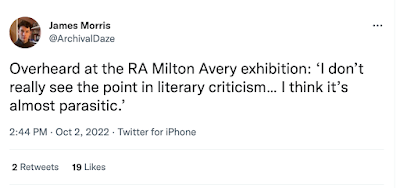
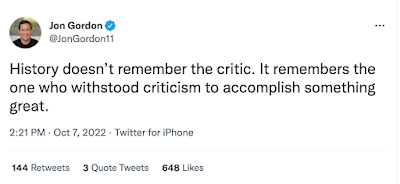
And I give thanks to Ryan Ruby for his commitment to reviewing such an uninspiring novel; a thankless task for the most part. Indeed, no thanks is often to be preferred. I've often received abusive comments or emails. Suspicion of reviewers and critics is a natural by-product of the aura of art, arising wherever anxiety reigns; Twitter being the go-to for examples:

Of course, many animals rely on parasites to maintain good health, and human life depends on bacteria living in us, so why not art? "Almost" may then be the most damning word here. And I wonder how Mr Gordon, best-selling author of 26 books "inspiring people and organizations to work with more vision, passion, positivity, and purpose", might explain how something great comes to be recognised as great. Anyway, why is he being so critical? Presumably critics should ignore him to accomplish something great.

This is not to say I don't have any problems with reviewing and criticism. The meagre output on this blog this year is the result of an overwhelming reluctance to follow the sirens that draw one inexorably toward the clichés of the form ("deals with", "tackles", "we meet"). It has become a process of "arduous vulgarization", a phrase used in What is the Purpose of Criticism?, a short essay by Blanchot from which this blog gets its name, though this is only one definition of criticism he suggests without committing to it. While I recognise my reluctance as an unwillingness to do the work, at the same time the purpose Blanchot offers helps me to recognise that it may also be a problem with the guidelines John Updike set out that otherwise dominate.

The purpose he commits to adapts Hölderlin's metaphor of the poem (made more famous by Heidegger) as a bell in the open air that becomes out of tune as it is coated by snowfall, with the snow standing for unpoetic language, which for Heidegger is the language of commentary. For Blanchot, however, criticism is the sound of the snow becoming nothing "within the heated agitation it instigates". It is this nothingness that allows the literary work to be what it is:

Critical discourse is this space of resonance within which the unspoken, indefinite reality of the work is momentarily transformed and circumscribed into words. And as such, due to the fact that it claims modestly and obstinately to be nothing, criticism ceases being distinguished from the creative discourse of which it would be the necessary actualization or, metaphorically speaking, the epiphany.  [Translated by Stuart Kendall]

But what does "the unspoken, indefinite reality of the work" mean? As readers, we know this as the basic fascination of reading a creative work (however labelled), that which agitates a need to speak what is unspoken and make definite what is indefinite. Except we resort to descriptions of overt subject matter ("deals with", "tackles") and protagonists ("we meet"), to the language of evaluation and social utility, making Blanchot's hyperbolic abstractions appear uselessly pretentious, or at least anachronistic. The impression is backed up when at the end of the essay he asks why there are complaints that criticism no longer knows how to judge, a complaint that certainly cannot be made today, as novels are judged by their own quality of judgement; specifically, to judge for us, to reflect our virtue back at us, and so burying the experience of the unspoken and the indefinite: "It is not criticism that lazily refuses to evaluate," Blanchot says, "it is the novel or the poem that shirks evaluation because it seeks affirmation outside every value system." Criticism as it disappears thereby becomes "closely related to one of the most difficult, but most important tasks of our time", which is "preserving and ... liberating thought from the notion of value".

I'm not sure what this means, at least how to express what it means, nor how might be done today, but I give thanks for these words in which there is a profound distance from industry standards as they go in the opposite direction to the utilitarian and the technical, the journalistic and the academic; untimely would then be a more accurate characterisation. In this way it exposes itself to the space outside of time, or just an outside, to which as readers we are exposed to in creative works (however labelled); not another world in terms of a facile escapism but "the other of all worlds", in which we encounter a part of what it is to be human, that which we do not recognise, cannot recognise, refuse to recognise, or that which frightens us, and from which we flee to narrativised punditry for refuge. Perhaps instead it is the novel that has become anachronisitc.

Monday, September 19, 2022

Ultimate things: The Aphorisms of Franz Kafka

Although we are unmusical, we have a tradition of singing
    Josephine the Singer, or the Mouse Folk

The first reason to celebrate Shelley Frisch’s new translation into English of Kafka’s short prose written in the village of Zürau, now Siřem in the Czech Republic, is that this is the first time they have been presented in book form alongside the German. The original is lacking from previously published translations into English: the Muirs’ in 1946, Kaiser’s and Wilkins’ in 1954, Malcolm Pasley’s in 1994, and Michael Hofmann’s in 2006. The second reason is that it is the first time they have been accompanied by a commentary, in this case by Kafka’s esteemed biographer Reiner Stach.

An exception to both is Michael Cisco’s blog and subsequent 260-page PDF made available in 2013, which is perhaps more faithful to the original as Kafka also never published them as a book. 

All this should remind us of the disorder in which Kafka’s work has been otherwise presented in English: multiple editions in multiple translations with only the occasional a sniff of scholarship. Germany has had a critical edition for over thirty years and in France this year a two-volume Pléiade boxed set was published in a new translation with everything Kafka wrote presented in chronological order. It is a minor scandal that an equivalent is lacking in English. Ross Benjamin's new translation of the diaries will provide some mitigation when it's published in January next year.

It is a disorder, however, that was there from the start: disordered chapters of unfinished novels, stories published and unpublished, sketches and parables, letters, doodles, the diaries of course, and, in the case of the aphorisms – Stach describes them as a "chaotic set of notes" – covered in corrections and crossings out. Or, rather, disorder was there from the end – of Kafka's life that is, although he didn't see it quite that way, as the aphorisms reveal. 

No doubt the disorder is why the Zürau aphorisms are nowhere near as well known as the novels and stories, though their brevity and generic uncertainty must be the main factor. In his preface to the Penguin Syrens edition pictured below, Gabriel Josipovici says the notes aren't really aphorisms, and while they may remind readers of "maxims, or parables, or reflections...or tiny stories", they aren't quite any of these either. Such labels, he adds, imply authority and control while the disorder in which they have come down to us and the biographical conditions under which they were written imply the opposite of both. This led to Maurice Blanchot's suggestion that Kafka instructed Brod to destroy his manuscripts because he saw his work “condemned to increase universal misunderstanding”. Destruction is itself a form of order and explains why our fascination with the instruction and its betrayal runs parallel to our fascination with finding order in the work.

The aphorisms were written in the aftermath of the bloody eruption of TB, the breaking off of his engagement to Felice Bauer, and in the shadow of a negligible literary career. On a visit back to Prague, Kafka told Max Brod that his task in Zürau was to "Become clear about ultimate things". Stach says this is an allusion to Otto Weiningers 1904 book Über die letzen Dinge "with which he was definitely acquainted" and which approaches "the pinnacles that defined western metaphysics", listed here as evil, truth, belief and the world of the spirit, and which he did by seeking, as Stach says, "the pithiest linguistic formulation".

Not that this creates an order, as many of the aphorisms don't obviously fit a metaphysical category. Here's Aphorism 2 in Kaiser's and Wilkins' translation:

All human errors are impatience, the premature breaking off of what is methodical, an apparent fencing in of the apparent thing.

I was very taken with this when I copied it into an exercise book during the excited naivete of youth. I don't know why it meant so much then, nor where I read it, as I had access only to the novels, stories and a disintegrating copy of the diaries. While the enchantment of those days has dissipated, the repetition of "apparent" has an appeal I recognise from my later discovery of Thomas Bernhard; a repetition acting, I suspect now, as a reflexive delay to interrupt impatience. Read in isolation like this, an aphorism can lodge in one's memory. Here's another, this time in Frisch's translation:

How can one take pleasure in the world other than when fleeing to it?

Wie kann man sich über die Welt freuen, ausser wenn man zu ihr flüchtet?

Which I need to compare to Pasley's:

How can one take delight in the world unless one flees to it for refuge?

The first translation is more accurate because the German for 'refuge' (Zuflucht) is not in the original. The second I had already memorised and without the extra words I have a curious sense of loss. I borrowed that part for the title of a post on re-reading Blanchot's The Space of Literature, as it challenged the rote understanding of literature as an unproblematic escape, thereby offering a renewed appreciation of the relation of book and world.

Here are the previous translations of Aphorism 2:

Michael Hofmann's:

All human errors stem from impatience, a premature breaking off of a methodical approach, an ostensible pinning down of an ostensible object.

The Muirs':

All human error is impatience, a premature renunciation of method, a delusive pinning down of a delusion.

And Malcolm Pasley's:

All human errors are impatience, a premature breaking-off of methodical procedure, an apparent fencing-in of what is apparently at issue. 

Perhaps instead multiple translations condemn a work to universal disenchantment.
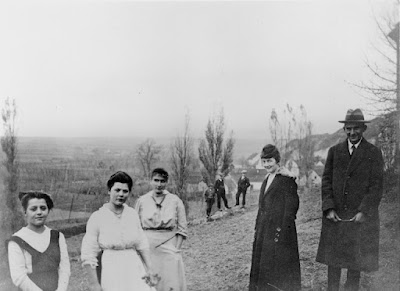
Kafka in Zürau

What's new with Shelley Frisch's translation and Reiner Stach commentary is that the aphorism is given a precise context:

Alle menschlichen Fehler sind Ungeduld, ein vorzeitiges Abbrechen des Methodischen, ein scheinbares Einpfählen der scheinbaren Sache.   

All human errors are impatience, a premature breaking-off of a methodical approach, an apparent use of posts to prop up the apparent objective.

In this case, market gardening in Zürau, which Kafka had witnessed and taken part in during his eight months there. Einpfählen we're told is a word used in horticulture and means "to prop up and stablize young fruit trees ... or as posts to enclose a pasture". (Note the faint repetition of Fehler in Einpfählen in addition to the other one.) As a blogger, I'm well aware that a series of posts may well be an error as they likely prop up a tree of misunderstanding and misappropriation. Such facetiousness is meant not only in jest, as the appropriation of the double meaning leads back to ultimate things

When a historical category loses its meaning and threatens to disappear, an opportunity arises that has a strange consequence.

The first sentence of The Yield, Paul North's book on the Zürau aphorisms, to which he gives order by calling the notes a "treatise", refers to the category "Jew" in Kafka's time as "becoming too diverse to signify one thing" and prompted Kafka and others such as Franz Rosenzweig to rethink it. The general observation is not new: in 1938 Walter Benjamin told Gershom Scholem that "Kafka's work represents a sickening of tradition" and "Only the products of its decomposition are left", both of which echo Weber's notion of modernity's disenchantment of the world. The lack of metaphysical overtones in Aphorism 2 would explain my excited connection as it can be applied to any "apparent thing" of the moment, with the new context giving it a specific action. Aphorism 3, however, takes the theme to a pinnacle:

There are two cardinal human sins, from which all other derive: impatience and laxity. Impatience got them expelled from paradise; indolence keeps them from returning. Perhaps, though, there is only one cardinal sin: impatience. Impatience got them expelled; impatience keeps them from returning.

This is certainly worthy of a commentary, but what can the category Paradise and those listed above mean to readers now if decomposition is complete and the presence of what constituted ultimate things in Kafka's time has disappeared in ours? We may imagine paradise via the old masters, but a tropical beach is more likely to be to the fore in our minds than the Garden of Eden. Reading Aphorisms 2 and 3 thereby encapsulates the experience of reading the 109 aphorisms together, oscillating between intimacy and rejection. 

In recalling my first reading of Aphorism 2, I associated it with Josipovici's essay An Art for the Wilderness written to mark the fiftieth anniversary of Kafka's death (and published in The Lessons of Modernism). But it isn't there. Instead, decades after first reading it, I rediscovered his experience of such an oscillation. The essay begins by discussing the discovery of the books we love and those that pass us by because they came at the wrong time. With those we love, "there is always the sense of an instinctive understanding, an awareness that what is lacking is really only the ability to make such understanding fully conscious":

Kafka is the only author I know to whom this does not apply. My own experience may be special in this respect, but I have found that, from the moment I began to read him, I felt at once infinitely close to him and infinitely distant. And ever since that time, as I have read and reread his novels and stories and diaries and notebooks and more and more of the voluminous correspondence that is slowly being made available, I have never had any sense of a gradual growth in understanding.

This experience is one that deserves more attention, and not just in Kafka. The furthest we may find ourselves is in Aphorisms 6 and 54, incidentally closer to the traditional form of aphorism:

The decisive moment of human development is everlasting. That is why the revolutionary movements grounded in intellect, which deem invalid everything that has gone before, are correct, for as yet nothing has happened.

There is nothing other than a world of the spirit; what we call the world of the senses is the Evil in the spiritual realm, and what we call Evil is only a momentary necessity in our eternal development.

As with Paradise, we are far removed from Evil with a leading capital and that of an everlasting spirit, let alone the latter taking precedence over the world of the senses. The ultimate things present to us as literature only; echoes from words become hollow. We may move closer to Kafka if we follow what he expressed in Kafka's famous letter to Brod post-Zürau that writing is "the reward for serving the devil", which then becomes a lament about having spent so much of his life writing and not living: "I died my whole life long and now I will really die." What, we wonder, albeit silently, off the literary stage, is the point of writing in respect of living and dying? Our impatience to answer has become literary appreciation, commentary, interpretation, blogging indeed; a frantic search for labels to prop up what has long since withered. For Kafka, at the end, at the apparent end, writing is an engagement with the sickening categories, their meaning and lack of meaning. The "pithiest linguistic formulation" is then not so much a genre choice as an undoing of authority and control, his words and theirs. Benjamin highlights the form of when criticising hasty theological readings of Kafka's work, such as the castle in The Castle being the seat of grace: 

it is the fact that his books are incomplete which shows the true working of grace in his writings. The fact that the Law never finds expression as such – this and nothing else is the gracious dispensation of the fragment.

Reading the aphorisms and the commentary prompted me to wonder if this oscillation between infinite closeness and infinite distance, an oscillation that is a single experience, explains the comparatively immobile experience of reading much of contemporary literature. When I think of the new publications that have meant most to me over the years, those that prompted a need to speak in response, to understand what the experience meant for me, and by extension for writing, I recognise, despite my confusion about this need – embarrassment even – a pattern of opening onto "ultimate things" albeit in variously indirect and necessarily incomplete manner – Knausgaard's books are the prime example – when I was unmoved by those I supposed I ought to be given how similar they are in many ways (curiously, another author whose surname begins with K may be the prime example here). As modern readers, we are like the mouse folk in the final story Kafka prepared for publication gathering to listen to Josefine sing or, rather, apparently sing, because the narration tells us it may not be singing at all but a "piping" expressing nothing distinct from the common piping of the populace who nevertheless gather to listen in silence (Kafka is almost as explicit about questioning the value of art in his work as in his letters). We seek order and understanding to convince ourselves that the song is real and ongoing, even if both are proof of the opposite. In the aphorisms, nevertheless, we can sense something in the distance, not only in the otherwise decomposed nouns and in the play of images and ideas, but perhaps more deeply in the delay of impatience produced by apparent and apparentscheinbares and scheinbaren – and in the quiet echo of Fehler in Einpfählen, now in an English edition for the first time.

Contact

Please email me at steve dot mitchelmore at gmail dot com.

Blog Archive

Contact steve dot mitchelmore at gmail.com. Powered by Blogger.