Saturday, September 30, 2006
Trost in translation
"Thomas Bernhard in the transmission without name over the death, the pressure, the fear, the music the life and hold to end the mouth."

Tuesday, September 26, 2006
Further to Chavez and Chomsky
It's worth pointing out that one of the "facts" making up the famous story of President Hugo Chavez's recommendation to read Chomsky was ... well, made up.
It was repeated in all the stories I saw. Here's one example: in the Philadelphia Inquirer, Carlin Romano wrote:
It was repeated in all the stories I saw. Here's one example: in the Philadelphia Inquirer, Carlin Romano wrote:
Never one to get his facts completely straight, Chavez held a post-speech news conference in which he expressed regret that he had not met Chomsky ... before the author's death, sentencing the still-quite-living 77-year-old emeritus professor to a new form of state execution.As the resourceful David Sketchley points out, the original story is somewhat different. Reuters reported that:
The dark-skinned, mixed race leader told New Yorkers to read Abraham Lincoln and Mark Twain as well as modern thinkers like Noam Chomsky and John Kenneth Galbraith, lamenting he could not meet Galbraith before he died in April at age 97.Sketchley assumes there are only three possible explanations for Romano's actions, which he puts to the author:
1. You have lifted your interpretation from another source without checking its veracity for yourself."Whichever explanation is correct" he adds "it is a scandal on a par with the NYT Jason Blair affair." Of course, it will receive equal attention in the corporate media and blogosphere, won't it?
2. You have mistranslated Chavez' words.
3. You have 'edited' Chavez' words yourself in order to make him look stupid.
Saturday, September 23, 2006
Hugo's there
What could be more appealing to our literary hopes and wishes than President Chavez's friendly advice to the young of the USA: set aside Superman and Batman to read authors like Noam Chomsky? ("[Hegemony or Survival] is an excellent work to understand what’s happened in the world in the 20th Century, what’s currently happening".)
Not much, I'd imagine. However, it prompts that other tireless promoter of world literature and literacy to call him a clown. How sad. Unfortunately this is not the first time it has sneered.
This is yet more evidence to back up Medialens' analysis Ridiculing Chavez, an examination of techniques used by the corporate media to marginalise this unique icon of living socialism. It has a significant task to complete. As Chomsky himself explains:
Not much, I'd imagine. However, it prompts that other tireless promoter of world literature and literacy to call him a clown. How sad. Unfortunately this is not the first time it has sneered.
This is yet more evidence to back up Medialens' analysis Ridiculing Chavez, an examination of techniques used by the corporate media to marginalise this unique icon of living socialism. It has a significant task to complete. As Chomsky himself explains:
At issue in [South America], as elsewhere around the world, is alternative social and economic models. Enormous, unprecedented popular movements have developed to expand cross-border integration — going beyond economic agendas to encompass human rights, environmental concerns, cultural independence and people-to-people contacts.And we daren't encourage that do we?
Friday, September 22, 2006
That would be an ecumenical matter
Waggish discusses the "ecumenical" editorial policy of the TLS. I tend to agree with him. Despite quietly seething when Washington-based empire loyalists like Edward Luttwak and, this week, Kenneth Anderson are allowed to soil the pages without balance from the left (in both reviewers and books reviewed), I do appreciate its non-political coverage.
This week's edition has a review by somebody or other of William Wall's collection of stories No Paradiso, not online. The Financial Times' review of it is online however, and Rachel Aspden isn't keen on its "smart-aleck protagonists and relentless tics of reference". The TLS review barely mentions them, due mainly to space but also because they don't get in the way. In fact, to that reviewer they opened up a mysterious, echoing void beneath the stories.
Generally, such allusions embarrass the fashion-conscious. It's odd how contemporary films win knowing smiles when they nod toward famous movies, yet books aren't allowed such leeway - unless, of course, it's not Horace or Dante's Inferno they mention but daytime TV and Heat magazine.
This week's edition has a review by somebody or other of William Wall's collection of stories No Paradiso, not online. The Financial Times' review of it is online however, and Rachel Aspden isn't keen on its "smart-aleck protagonists and relentless tics of reference". The TLS review barely mentions them, due mainly to space but also because they don't get in the way. In fact, to that reviewer they opened up a mysterious, echoing void beneath the stories.
Generally, such allusions embarrass the fashion-conscious. It's odd how contemporary films win knowing smiles when they nod toward famous movies, yet books aren't allowed such leeway - unless, of course, it's not Horace or Dante's Inferno they mention but daytime TV and Heat magazine.
Monday, September 18, 2006
The civilisation of the book
Of the 813 pages of Joakim Garff's biography of Kierkegaard, I've read only 100. But I intend to reach the end, to read everything and in order. I was horrified when a friend told me he began 180 pages in to read about Kierkegaard's relationship with Regine Olsen. Apparently that's when it becomes interesting (so far it isn't terribly). So why do I insist on plodding through the pages in order?
Actually, on page 100 Garff tells of the actions of two early editors of Kierkegaard's papers that offers an answer. Heiberg and Kuhr divided the material into three groups, A for journal entries, B for his pseudonymous and nonpseudonymous writings and C for notes from his studies. This systematization, Garff explains, was further divided into subgroups: aesthetic, philosophical, and theological. He comments that this
The more I thought about possible alternatives, I realised my intention to read each page in turn was not itself far removed from either of the above. The impulse to organise, contain and control - an impulse which is inherent to reading and writing; perhaps also inherent to living on.
It helps explain a line from Blanchot that has stayed with me:
Actually, on page 100 Garff tells of the actions of two early editors of Kierkegaard's papers that offers an answer. Heiberg and Kuhr divided the material into three groups, A for journal entries, B for his pseudonymous and nonpseudonymous writings and C for notes from his studies. This systematization, Garff explains, was further divided into subgroups: aesthetic, philosophical, and theological. He comments that this
was laudable in principle but is unfortunate in practice, because it obscures the range of Kierkegaard's journal entries and gives the reader a false notion of uniformity and consistency in the profusion of texts.I'm not sure how laudable it is to systematise such writings in the first place, though I suppose it's not far removed from Garff's own project which perhaps gives a false notion of Kierkegaard's life - the one he lived forwards and we try to understand backwards.
The more I thought about possible alternatives, I realised my intention to read each page in turn was not itself far removed from either of the above. The impulse to organise, contain and control - an impulse which is inherent to reading and writing; perhaps also inherent to living on.
It helps explain a line from Blanchot that has stayed with me:
Whatever we do, whatever we write [...] literature takes possession of it, and we are still in the civilisation of the book.Later, he explains that:
If one ceased publishing books in favor of communication by voice, image, or machine, this would in no way change the reality of what is called the 'book'; on the contrary, language, like speech, would thereby affirm all the more its predominance and its certitude of a possible truth. In other words, the Book always indicates an order that submits to unity, a system of notions in which are affirmed the primacy of speech over writing, of thought over language, and the promise of a communication that would one day be transparent and immediate. [trans Susan Hanson]One might presume then that those early editors of Kierkegaard were neutralising his disruption of that submission to unity. But Garff reminds us that the first editor of Kierkegaard's papers was Kierkegaard himself.
After my death, this is my consolation: No one will be able to find in my papers one single bit of information about what has really filled my life; they will not find the inscription deep within me which explains everything, which often makes what the world would call bagetelles into events of enormous importance to me, but which I, too, view as insignificant when I remove the secret note that explains everything.
Sunday, September 17, 2006
A voice comes to one in the dark
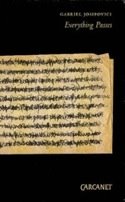
A room.
He stands at the window.
And a voice says: Everything passes. The
good and the bad. The joy and the sorrow.
Everything passes.
There are some books whose first lines, the opening lines, are enough. Reading them, you know this is it. This is why you read.
For me, the first in memory was in 1986: the beginning of chapter 2 of Kundera's The Unbearable Lightness of Being (after the digression about Eternal Return).
I have been thinking about Tomas for many years. […] I saw him standing at the window of his flat and looking across the courtyard at the opposite walls, not knowing what to do.Then in summer 1989, the first line of Peter Handke's Across:
I shut my eyes and out of the black letters the city lights took shape.A year later, it was Thomas Bernhard's Concrete.
The more one reads, however, the less it seems to happen. Books become more and more alike. They do what novels do. That's all. Sometimes it seems it'll never end. But when I read the first paragraph of Gabriel Josipovici's new, sixty-page novel Everything Passes, it happened again.
Wednesday, September 13, 2006
Deutschland, doucheland
The pleasantly-surprising headline review in the TLS last week (and which I got round to reading only this evening) was Rectifications along the Rhine, a review of David Blackbourn's The Conquest of Nature, a "wide-ranging and highly original study" showing that "the management of water has been central to the making of modern Germany". It features some startling facts - "More than 2,000 islands and outcrops – comprising a billion square metres of real estate – were excavated out of existence" - and is told from an array of perspectives: "His protagonists include engineers, fisherfolk and peasants, but also eels, alders and beetles."
At 500-pages, it begins to sound like one of those "ambitious" novels many readers seem to want; a grand delta of narratives promising to sluice free the congestion of modern consciousness into one big, becalmed sea. The reviewer Christopher Clark suggests the book is less anachronistic than that.
At 500-pages, it begins to sound like one of those "ambitious" novels many readers seem to want; a grand delta of narratives promising to sluice free the congestion of modern consciousness into one big, becalmed sea. The reviewer Christopher Clark suggests the book is less anachronistic than that.
Blackbourn does not exactly "think like a river", as the environmentalist historian Donald Worster has suggested we should, but his book has a meandering, riverine motion.This is because his writing
has always been informed by a critical awareness of how grand narratives – whether pessimistic or optimistic – can distort and impoverish our understanding by imposing retrospective coherence on a profusion of contradictory impulses.
Monday, September 11, 2006
A review attached
One has written a review of Ron Butlin's Belonging for ReadySteadyBook (and having mentioned that esteemed site, don't miss the recent interviews with Robert Kelly and James Reidel). I don't quote much from the novel but here's the first one:
It would be a glorious, incandescent, mind-expanding, post-craziness fuck ... and afterwards we'd promise each other the world all over again. Letting ourselves be wounded and healed - we called this love. And, for those brief moments, it probably was. Craziness, then forgiveness. More craziness, the more forgiveness. That was love. That was us.I mention this here only because I didn't mention there that it reminds me of the Afterword Nabokov adds to later editions of Lolita. He tells of how a reader of the manuscript
suggested that his firm might consider publication if I turned Lolita into a twelve-year-old lad and had him seduced by Humbert, a farmer, in a barn, amidst gaunt and arid surroundings, all this set forth in short, strong, 'realistic' sentences ('He acts crazy. We all act crazy, I guess. I guess God acts crazy.' Etc.).I love that. I am drawn to such repetition. Even the repetition of fullstops at the end. Repetition rules.
Subscribe to:
Posts (Atom)
Subscribe to This Space


 Posts
All Comments
Posts
All Comments

