The problem is not religion but religious orthodoxy and the form it takes in human institutions. Throughout history, most moral thinkers - from Socrates to Christ to Francis of Assisi - eschewed the written word. Once moral teachings are written down they become, in the wrong hands, codified and used to enforce conformity, subservience and repression. Writing, as George Steiner has recognised, freezes speech. The moment the writers of the gospels recorded Jesus's teachings, they began to kill their message. There is no room for prophets within religious institutions - indeed within any human institution. Tribal societies persecute prophets; open societies tolerate them at their fringes. Today, our prophets are usually found not within the church but among artists, poets and writers who follow, as Socrates or Jesus did, their inner authority, an authentic religious impulse.When, the other day, I asked, rather vaguely: "what does an excessive concern for words and sentences mean for novels?", I suppose the answer is that novels must try very hard not to be written.
Thursday, May 31, 2007
The book is not great
The New Statesman has a satisfyingly trenchant review by Chris Hedges of Christopher Hitchens' God is Not Great (and an amusing caricature of the author too). It's welcome even if it has always seemed clear to me that Reason as endorsed by Hitchens, Clive James and other media favourites, is also a dangerously false god. End of. But I was particularly taken with a paragraph in which Hedges suggests the problem is far more subtle:

Tuesday, May 29, 2007
Schopenhauer, where are you now?
Grim news I'm afraid. A friend reports from the Charleston Festival that Patrick Marber, so long a favourite as a writer and performer on The Day Today and Paul Calf's Video Diary (during which he cries out the blog's title), is embarking on a screenplay of Ian McEwan's Saturday. How depressing that people are prepared to put up vast amounts of money to fund this liberal wankfest. Time for another link to Ellis Sharp's seminal essay on this politically and artistically pernicious little novel.
Worse, Ronald Harwood, who was Marber's co-panellist at Charleston, announced that he's to write the screenplay of Irène Némirovsky spectacularly-overrated and badly-written novel Suite Française. Harwood is a good choice though as he admits to having no pretensions as an artist, writing screenplays solely because it's a good life. I suspect, however, that if one took him at his word, and placed his work accordingly, he and all those nodding approvingly at such commonsense would cry "Snobbery! Elitism!".
Worse, Ronald Harwood, who was Marber's co-panellist at Charleston, announced that he's to write the screenplay of Irène Némirovsky spectacularly-overrated and badly-written novel Suite Française. Harwood is a good choice though as he admits to having no pretensions as an artist, writing screenplays solely because it's a good life. I suspect, however, that if one took him at his word, and placed his work accordingly, he and all those nodding approvingly at such commonsense would cry "Snobbery! Elitism!".
A review of Eeeee Eee Eeee
Earlier this month, lamenting the paucity of genuinely original novels, I wrote: I should admit that there is a novel published this month to which I can say: this is it ... But that'll have to wait until I find the words. Well, now I have found the words - about 1600 of them - and Ready Steady Book has kindly posted them all as a review of Tao Lin's first novel.
Monday, May 28, 2007
Needles, Hay-on-Wye-stacks
Despite the ice-cold stair rods bouncing off my hands and face, I listened with interest to John Banville on Bookworm talking about his Benjamin Black thriller Christine Falls. He said that, writing as John Banville, he would consider himself lucky if he had written 20 words by lunchtime. On the first morning writing as Benjamin Black, he wrote 2,000. For him it was “a whole new way of writing”; “when I write as Benjamin Black” he said, “I write as a craftsman”.
Later, as I descended towards the village where a niece of Kafka's ended her days, I listened to Beryl Bainbridge talking on the Guardian's Hay festival podcast about a new film following a year in her life. Sarfraz Manzoor asked about the writer's block mentioned in the film. Was it, he asked, a case of running out of stories? "No, it's not the stories you're searching for, it's the words and how to construct it in sentences; that's the problem."
There are stories cascading onto our heads, I thought as the rain abated, yet the words run on down the drain. Is this ever discussed in reviews? How might it be discussed? What does an excessive concern for words and sentences mean for novels? Questions, questions, but the literary pages demand only stories, ever more stories about stories. This morning, I read that Gordon Brown chose to read Sebastian Faulks' production-line novel Engleby because it was recommended to his wife by Mariella Frostrup, the smiling presenter of Sky's book programme. It was then I could see why I feel both uncomfortably close to "the world of books" and infinitely distant. While Mariella and Mrs War Criminal frolic in the hay, I'm impatient for the needle.
Later, as I descended towards the village where a niece of Kafka's ended her days, I listened to Beryl Bainbridge talking on the Guardian's Hay festival podcast about a new film following a year in her life. Sarfraz Manzoor asked about the writer's block mentioned in the film. Was it, he asked, a case of running out of stories? "No, it's not the stories you're searching for, it's the words and how to construct it in sentences; that's the problem."
There are stories cascading onto our heads, I thought as the rain abated, yet the words run on down the drain. Is this ever discussed in reviews? How might it be discussed? What does an excessive concern for words and sentences mean for novels? Questions, questions, but the literary pages demand only stories, ever more stories about stories. This morning, I read that Gordon Brown chose to read Sebastian Faulks' production-line novel Engleby because it was recommended to his wife by Mariella Frostrup, the smiling presenter of Sky's book programme. It was then I could see why I feel both uncomfortably close to "the world of books" and infinitely distant. While Mariella and Mrs War Criminal frolic in the hay, I'm impatient for the needle.
Saturday, May 26, 2007
Weekend bleeding
Both the Inferno and, in particular, the Purgatorio glorify the human gait, the measure and rhythm of walking, the footstep and its form. The step, linked with breathing and saturated with thought, Dante understood as the beginning of prosody.Lately, rather than write in my minimal spare time, I've gone out walking or cycling. Not in order to get away from writing but in order to get back to it. Mandelstam's words above reminded me. Not writing is when I feel that I am making headway; writing. One steps through doubt; the tyres hurtle on toward the completion of thought. Perhaps too fast.
The physical act of writing is itself a time of stasis, non-time. Almost non-thinking too. Anti-thought instead perhaps, thinking against the ease of movement. I don't like it. It's why I write so little and say the same thing, more or less, so often. I also walk and cycle the same few routes.
So, I was (somehow) thinking: are there any (literary) subjects you think I should write about instead?

Monday, May 21, 2007
Bernhard bust
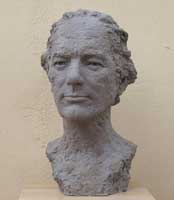 Sculptor Lucie Geffré has produced a very impressive and, one has to say, uncanny bust of our favourite Austrian novelist. It even reproduces his bad skin!
Link via the wonderful thomasbernhard.org.
Enough furthermores
Gilles d'Aymery reviews Hans von Sponeck's A Different Kind of War: The UN Sanctions Regime in Iraq. Has it received reviews elsewhere? It was published last year by Berghahn Books but I don't remember seeing the interviews and reviews it seems to demand.
The book outlines the impact of recent history of Iraq on its people from the point of view of the former UN Assistant Secretary General and UN Humanitarian Coordinator in Iraq: Saddam's invasion of Iran, the invasion of Kuwait, the second Gulf War, the sanctions, then the Oil-for-Food Programme which was meant to alleviate the extreme suffering caused by the sanctions, but which, Sponeck reveals, meant that "the Iraqis were financing their own physical annihilation". It all becomes too much for d'Aymery and he departs from the usual sober review:
The book outlines the impact of recent history of Iraq on its people from the point of view of the former UN Assistant Secretary General and UN Humanitarian Coordinator in Iraq: Saddam's invasion of Iran, the invasion of Kuwait, the second Gulf War, the sanctions, then the Oil-for-Food Programme which was meant to alleviate the extreme suffering caused by the sanctions, but which, Sponeck reveals, meant that "the Iraqis were financing their own physical annihilation". It all becomes too much for d'Aymery and he departs from the usual sober review:
Enough “furthermores“... This is where anger truly sets in. Hans von Sponeck catalogues the state of the Iraqi people: Child malnutrition, child mortality, calories per capita, adult literacy, per capita income, primary and secondary school enrollment, daily per capita production of water, sanitation... each and every benchmark being so dramatically horrible that one cannot read those pages without a sense of disgust, outrage, and shame. Neither Sade nor Lautréamont nor Genghis Khan could have devised such barbarian policies that turned out to be real weapons of mass destruction ... of a people. We did this to our fellow human beings very deliberately, methodically, and callously. How could we have done so without an upheaval in our human construct?We got Ian McEwan's Saturday didn't we?
Subscribe to:
Posts (Atom)
Subscribe to This Space


 Posts
All Comments
Posts
All Comments

