Richard Seymour of Lenin's Tomb asks: "Is it possible to survey Britain's most celebrated littérateurs and not find them repulsive?". Based on their novels alone, the answer has to be a resounding NO! But that's not what provoked our blogger's question. It's in response to Ian McEwan's latest interview in which he defends his "dear friend" Martin Amis from vaguely attributed accusations of racism. Along the way he reveals that "I myself despise Islamism". While Seymour answers better than anyone what McEwan says, I'll take issue with what he doesn't.
However "controversial" Amis's comments or "brave" McEwan's position on the indigenous culture of neo-colonies, both are red herrings. Nowhere in this interview does McEwan express any regret, let alone horror and shame, at his nation's responsibility for the deaths of more than a million people in Iraq and Afghanistan. (There's not a word about his fictionalised apologetics either). One would have thought the continuing aggression of the most powerful army in the history of mankind and its allies would be more pressing than media-enabled paranoia about a foreign religion. In the last century, should the population of Weimar have been more concerned with rumours of Jewish "blood libels" than what was being carried out in their name just up the road?
While McEwan asks for his fellow subjects to start "to reflect on Englishness: this is the country of Shakespeare, of Milton, Newton, Darwin", he does not reflect that this is also the country of Prince "Bomber" Harry, a member of the English royal family involved in military attacks on civilians. During his time in Afghanistan, he is said to have guided fighter jets "towards suspected Taliban targets". In mitigation, McEwan can, with the rest of us, claim not to know what is really happening. After all, the London media that fawns over each of his claustrophobic and inorganic novels tends not to report that the "suspected Taliban" are often women, children, wedding parties and even herds of sheep. (Maybe we'd hear more about it if they lived in tower blocks).
All in all, it's a depressing lurch to the right. Twenty-five years ago, McEwan wrote the screenplay to The Ploughman's Lunch, a film that went against the political grain of the time. It showed in negative light Thatcherism's "promotion of self-interest, of ruthless dedication to obtain a desired goal". The main character is James Penfield, a social-climbing journalist played by Jonathan Pryce. He is writing a revisionist history of Britain's imperial adventure at Suez in 1956 in order to curry favour. As Channel 4's feature says, he is "keen to keep his political paymasters happy [by adopting] an extremely right-wing, partisan tone." There's a memorable scene at the end in which Pryce walks around the floor of the Conservative Party conference during Michael Heseltine's rallying speech. This was the famous post-Falklands War conference with the stage at the Brighton Centre designed to resemble the bridge of a battleship. It is as if Penfield is surveying the ruins of his own victory. As a person, he is empty; hollowed out by ambition. At the time I recall being struck by his definition of professionalism: "knowing instinctively what you can and cannot do".
Take a look The Afghan Victim Memorial Project and then try to curl up with the latest award-winning unit from one of our most celebrated literary professionals.
Showing posts sorted by relevance for query McEwan. Sort by date Show all posts
Showing posts sorted by relevance for query McEwan. Sort by date Show all posts
Sunday, June 22, 2008

Wednesday, October 19, 2022
The criticism of Lessons, the lessons of criticism
I give thanks to Ryan Ruby for his review of Lessons, Ian McEwan’s latest novel. It brings to our attention that rare thing, joy of joys, a novel telling the story of a life remarkably similar to the author’s own set against the backdrop of recent history. Ruby shows how the novel is the inevitable conclusion of a path he has followed for many years as, in all but two novels McEwan has produced since The Innocent in 1990, the “subject matter has been ripped from the headlines”:
As befits a regular of the international festival circuit with the occasional byline in the Guardian opinion page, [McEwan’s] treatment of issues such as the Iraq War, climate change, euthanasia, artificial intelligence and Brexit could be described as narrativized punditry.
In the hope of killing off the genre, the final two words should enter the critical lexicon alongside James Wood’s “hysterical realism”. Both are symptoms of the loss of confidence in the novel as an art form, as something in itself, something apart. Ruby spells out brilliantly how McEwan's concern for political virtue has the side-effect of neutralising real change, which conveniently aligns him with columnists at the news organisation that has championed his work. Only Ellis Sharp has spelled this out at length before now, in a blogpost sadly deleted, but reprinted in Sharply Critical. And of course there is John Banville's review of Saturday which, despite its prominence, doesn't seem to have taught McEwan ... a lesson.
The English novel scene epitomised by what Ruby shows to be the predictabilty and complacency of Lessons is the literary equivalent of the herd of independent minds currently sporting little badges of a blue and yellow flag who felt no compunction to wear one displaying (in chronological order) the Serbian flag, the Iraqi flag, the Afghan flag, the Libyan flag, the Syrian flag, or the Yemeni flag, and certainly not the flag of a certain part of Europe that has been under bombardment since 2014. This is not to say they supported the crimes done in their name – if they knew of them – but the culture doesn't demand awareness, and certainly not action, so for reasons John Pilger explains, their unimpeachable virtue disables any practical opposition to endless war:
In the 1970s, I met one of Hitler’s leading propagandists, Leni Riefenstahl, whose epic films glorified the Nazis. We happened to be staying at the same lodge in Kenya, where she was on a photography assignment, having escaped the fate of other friends of the Fuhrer.
She told me that the “patriotic messages” of her films were dependent not on “orders from above” but on what she called the “submissive void” of the German public. Did that include the liberal, educated bourgeoisie? I asked. “Yes, especially them,” she said.
For his narrativised punditry, the Leni Riefenstahl of Cool Britannia:
has been rewarded with increasing extra-literary prominence. In 2000, he was made a Commander of the Most Excellent Order of the British Empire by the late Elizabeth Windsor; in 2016, the Daily Telegraph named him ‘the 19th most powerful person in British culture’, an honour at once dubiously conferred and comically specific.
We can assume James Kelman is nowhere on that list.
And I give thanks to Ryan Ruby for his commitment to reviewing such an uninspiring novel; a thankless task for the most part. Indeed, no thanks is often to be preferred. I've often received abusive comments or emails. Suspicion of reviewers and critics is a natural by-product of the aura of art, arising wherever anxiety reigns; Twitter being the go-to for examples:
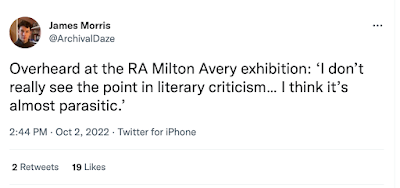
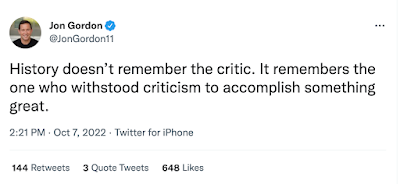
Of course, many animals rely on parasites to maintain good health, and human life depends on bacteria living in us, so why not art? "Almost" may then be the most damning word here. And I wonder how Mr Gordon, best-selling author of 26 books "inspiring people and organizations to work with more vision, passion, positivity, and purpose", might explain how something great comes to be recognised as great. Anyway, why is he being so critical? Presumably critics should ignore him to accomplish something great.
This is not to say I don't have any problems with reviewing and criticism. The meagre output on this blog this year is the result of an overwhelming reluctance to follow the sirens that draw one inexorably toward the clichés of the form ("deals with", "tackles", "we meet"). It has become a process of "arduous vulgarization", a phrase used in What is the Purpose of Criticism?, a short essay by Blanchot from which this blog gets its name, though this is only one definition of criticism he suggests without committing to it. While I recognise my reluctance as an unwillingness to do the work, at the same time the purpose Blanchot offers helps me to recognise that it may also be a problem with the guidelines John Updike set out that otherwise dominate.
The purpose he commits to adapts Hölderlin's metaphor of the poem (made more famous by Heidegger) as a bell in the open air that becomes out of tune as it is coated by snowfall, with the snow standing for unpoetic language, which for Heidegger is the language of commentary. For Blanchot, however, criticism is the sound of the snow becoming nothing "within the heated agitation it instigates". It is this nothingness that allows the literary work to be what it is:
Critical discourse is this space of resonance within which the unspoken, indefinite reality of the work is momentarily transformed and circumscribed into words. And as such, due to the fact that it claims modestly and obstinately to be nothing, criticism ceases being distinguished from the creative discourse of which it would be the necessary actualization or, metaphorically speaking, the epiphany. [Translated by Stuart Kendall]
But what does "the unspoken, indefinite reality of the work" mean? As readers, we know this as the basic fascination of reading a creative work (however labelled), that which agitates a need to speak what is unspoken and make definite what is indefinite. Except we resort to descriptions of overt subject matter ("deals with", "tackles") and protagonists ("we meet"), to the language of evaluation and social utility, making Blanchot's hyperbolic abstractions appear uselessly pretentious, or at least anachronistic. The impression is backed up when at the end of the essay he asks why there are complaints that criticism no longer knows how to judge, a complaint that certainly cannot be made today, as novels are judged by their own quality of judgement; specifically, to judge for us, to reflect our virtue back at us, and so burying the experience of the unspoken and the indefinite: "It is not criticism that lazily refuses to evaluate," Blanchot says, "it is the novel or the poem that shirks evaluation because it seeks affirmation outside every value system." Criticism as it disappears thereby becomes "closely related to one of the most difficult, but most important tasks of our time", which is "preserving and ... liberating thought from the notion of value".
I'm not sure what this means, at least how to express what it means, nor how might be done today, but I give thanks for these words in which there is a profound distance from industry standards as they go in the opposite direction to the utilitarian and the technical, the journalistic and the academic; untimely would then be a more accurate characterisation. In this way it exposes itself to the space outside of time, or just an outside, to which as readers we are exposed to in creative works (however labelled); not another world in terms of a facile escapism but "the other of all worlds", in which we encounter a part of what it is to be human, that which we do not recognise, cannot recognise, refuse to recognise, or that which frightens us, and from which we flee to narrativised punditry for refuge. Perhaps instead it is the novel that has become anachronisitc.
Sunday, January 13, 2008
Ian McEwan & blogs and Mark Kermode & book reviewing
So, Ian McEwan isn't keen on the "road-rage" tone of blogs and "the threads that come out of any given piece of journalism" (what ever that means).
Also, it's ironic that he contrasts his dislike of blogs with his admiration for Arts & Letters Daily. I gave up on that page several years ago because of its bigoted and philistine tone. Would he feel any different about the site had it linked as regularly (or even once) to one of our best literary blogs - now sadly retired - as it did to shrill neo-liberal propaganda? For of course, The Sharp Side was very good at holding McEwan to account for his actions. Among other revelations, it exposed his dining arrangements on the day tens of thousands of his fellow countrymen tried to hold their representatives to account for a criminal war or two, as well as providing a remarkable 5,500 word analysis of the politics of his most notorious novel.
The loss of Ellis' voice is regrettable for his incisive blogs on our foremost Establishment Literary Fictioner alone. Yet his retirement from blogging helps to emphasise from where blogging emerges: not from the necessity of making a living, or from an attempt to gain attention at any cost, but from passion and expertise in various fields; something that has to be done alongside another full-time life. It's no surprise that many give up. The only reward, it seems, is friendship.
Despite all this, I tend to share McEwan ideals about resisting the "nasty, truculent, aggressive edge" in book reviewing. Only a few novels really deserve it. Yet with Sir Howard Davies' comments about book reviewing culture still resounding, I wonder if it might benefit rather than ruin the literary culture in this country.
Think of the influence of the UK's most popular film reviewer. So many people listen to Mark Kermode on Simon Mayo's radio show precisely because of his quirky passion. Metafilter discussed his famous rant about Pirates of the Caribbean just last week. It's an indication of the hang-ups media folk have about literature that the literary equivalent - Mayo's Book Panel - does not have an expert reviewer but opinions from "members of the public". Last week, I even saw two actors giving their worthless judgments on Richard & Judy's Book Club! In order to bring Literature to the masses, it seems they feel the need to remove any offending literary content (as Joyce Carol Oates observed). The more bland and wet one is, the better. Yet of course, they want all the perceived cultural benefits of literary appreciation.
If Kermode decided to transfer his expertise to books, we'd probably never hear from him again. But we do need such a reviewer. Of course, I'd be willing to take on this heroic role, so long as I didn't have to read the god-awful books on their reading lists.
It seems that when people know they can't be held accountable, when they don't have eye contact, it seems to bring out a rather nasty, truculent, aggressive edge that I think slightly doesn't belong in the world of book reviewing.(Mmm, that string of adjectives reminds me of another). I'm as perplexed with this as The Literary Saloon is. Many blogs allow comments from readers precisely to generate the accountability of feedback, and there's about as much eye contact with its subject in print reviewing as there is in blogging.
Also, it's ironic that he contrasts his dislike of blogs with his admiration for Arts & Letters Daily. I gave up on that page several years ago because of its bigoted and philistine tone. Would he feel any different about the site had it linked as regularly (or even once) to one of our best literary blogs - now sadly retired - as it did to shrill neo-liberal propaganda? For of course, The Sharp Side was very good at holding McEwan to account for his actions. Among other revelations, it exposed his dining arrangements on the day tens of thousands of his fellow countrymen tried to hold their representatives to account for a criminal war or two, as well as providing a remarkable 5,500 word analysis of the politics of his most notorious novel.
The loss of Ellis' voice is regrettable for his incisive blogs on our foremost Establishment Literary Fictioner alone. Yet his retirement from blogging helps to emphasise from where blogging emerges: not from the necessity of making a living, or from an attempt to gain attention at any cost, but from passion and expertise in various fields; something that has to be done alongside another full-time life. It's no surprise that many give up. The only reward, it seems, is friendship.
Despite all this, I tend to share McEwan ideals about resisting the "nasty, truculent, aggressive edge" in book reviewing. Only a few novels really deserve it. Yet with Sir Howard Davies' comments about book reviewing culture still resounding, I wonder if it might benefit rather than ruin the literary culture in this country.
Think of the influence of the UK's most popular film reviewer. So many people listen to Mark Kermode on Simon Mayo's radio show precisely because of his quirky passion. Metafilter discussed his famous rant about Pirates of the Caribbean just last week. It's an indication of the hang-ups media folk have about literature that the literary equivalent - Mayo's Book Panel - does not have an expert reviewer but opinions from "members of the public". Last week, I even saw two actors giving their worthless judgments on Richard & Judy's Book Club! In order to bring Literature to the masses, it seems they feel the need to remove any offending literary content (as Joyce Carol Oates observed). The more bland and wet one is, the better. Yet of course, they want all the perceived cultural benefits of literary appreciation.
If Kermode decided to transfer his expertise to books, we'd probably never hear from him again. But we do need such a reviewer. Of course, I'd be willing to take on this heroic role, so long as I didn't have to read the god-awful books on their reading lists.
Sunday, July 23, 2023
A loss of problems
Martin Amis' novels were among those I read when I began reading novels – one read what was being talked about on television and in newspapers. Money was the first quickly followed by each and every one that preceded it, including the journalism in The Moronic Inferno, which I may have read twice, and London Fields in the year it was published. This was when I realised that reading Amis had been time well spent; time that from then on I would no longer waste. This was forgotten and reaffirmed several years later when I borrowed copies of The Information and Experience, and it was only out of duty that I read The Zone of Interest when I wrote something about Claude Lanzmann's Shoah.
The same can be said of the novels of Ian McEwan, Julian Barnes, Salman Rushdie, and JG Ballard, the big names of Britain’s literary scene in the 1980s and 90s, and Philip Roth and John Updike of the USA’s (the exception was Saul Bellow). Why did I feel mild indifference reading their novels compared to the entirely different feeling I got reading various European novels (and Saul Bellow)? To my surprise, the names of Amis, McEwan and Ballard have appeared several times on this blog over the years, often as I seek an answer to this question. The news of Amis’ death brought those early days back to me and now, with the death of Milan Kundera whose Unbearable Lightness of Being was the catalyst of recognition, I am thinking about it again.
I read various postmortem articles invariably focusing on Amis' style, many of which Jack Arden says in an excellent piece create "the impression that style was also more than this – something supra-personal”. I was certainly seduced by Amis’ style in Money – I remember the effect of reading the verb "sharking" on the first page (coincident no doubt with the "Martian" poetry I was reading at the time) – but evidently there wasn’t, for me, much more than style, and while I could assume this was because, as Terry Eagleton says, Amis "was the great poet of the postmodern metropolis", subject matter that sparks nothing in me, one could also say Proust was a great poet of the modern metropolis (in Sodom and Gomorrah at least), and my discovery of Proust never became a waste of time. Eagleton’s article would also suggest my lack of interest in their novels follows distaste for the liberal politics of "the Amis group" – to which he adds Christopher Hitchens, James Fenton and Clive James – except the writers whose work excited me did not do so for political reasons; Saul Bellow’s reactionary tendencies being evidence of that. But it’s here that Eagleton gets closer to the difference when he describes the rightward trajectory of the group: Hitchens, for example, moved from being a "practising Trotskyist at Oxford" to "dining with the architects of Western butchery in Iraq". But, he says, "the relation between politics and letters is more complex than that, as a glance at the great modernist writers would suggest":
Joseph Conrad was a deep-dyed conservative and misogynist with a virulent hatred of the political Left. Ezra Pound and Wyndham Lewis supported the fascist cause, while W.B. Yeats, a champion of plans to stop the poor from breeding, flirted with fascism as well. D.H. Lawrence was racist, sexist, homophobic and antisemitic, while T.S. Eliot was a high Tory who championed a quasi-fascistic French movement. Yet all of these figures were radicals — radicals of the Right rather than the Left — and the fineness of their work is related to the depth and breadth of their challenge to a liberal democracy in profound crisis. Besides, there were plenty of modernist experiments on the political Left as well.
Almost all of these writers thought deeply about politics, philosophy and the shape of a whole civilisation, which is hardly true of Clive James. Some of them were powerful visionaries, which is not quite how one would describe Julian Barnes or Ian McEwan. This is one reason why their work, taken as a whole, has never been equalled in the century or so which has passed since it appeared, and certainly not by the Amis group.
While I would dispute that the work of "the great modernist writers" has not been equalled, it's understandable that it appears this way, especially if one's focus is on the Anglophone sphere, as thinking deeply here has been replaced by a condition Wittgenstein defined in his own time:
Some philosophers (or whatever you like to call them) suffer from what may be called “loss of problems”. Then everything seems quite simple to them, no deep problems seem to exist any more, the world becomes broad and flat and loses all depth, and what they write becomes immeasurably shallow and trivial. (Translated by GEM Anscombe)
One can discern this condition across the entirety of Britain's public discourse. Behold in awe and reverence the deep thought underwriting this insight from an honorary member of the Amis group:

Amis himself said he never finished either one of Kafka's novels, but then again neither did Kafka. Very witty, of course, and characteristic: George Steiner once said an Englishman's corner-of-the-mouth "come off it" would have stopped Michaelangelo painting the Sistine Chapel and Beethoven composing the Fifth Symphony. Kafka's "failure" is thereby judged in the context of literary mastery rather than in relation to anything larger; Walter Benjamin, for example, said "it is the fact that his books are incomplete which shows the true working of grace in his writings".
One may object and point out the novels of Amis and McEwan address important issues, with former's books about terrorism, Stalin's Gulag and the Shoah (although curiously not one about crimes closer to home), and the latter's narrativised punditry drawing attention from literary journalists like never before; hardly shallow and trivial. Except the larger questions have been settled, as the Pope of scientism and Cardinal Hitchens insist, which leaves the novel seeking relevance in terms of a public profile, in an absurd war on cliché – the eternal return of a goldfish in its bowl – and in ambulance-chasing pseudo-journalism.
One might characterise the form of the novel as a search for an authority for itself, with genre providing prefab solutions, so a focus on parochial animations is an inevitable development of its Humanism; it demands constant movement to keep up with the times. But the shock of Martin Amis' death should remind us of the thin ice upon which such movement proceeds. Amis described the impulse behind his 1995 novel The Information as "an hysterical overreaction to the certain knowledge that you're going to die" and Julian Barnes, said to be the Gwyn Barry of that novel, wrote a book on the same knowledge. The horror of the self before the ultimate problem is an intensification of the writer's anxiety before the blank page, hence the blossoming of autofiction in the confluence of both.
The problem of the recognition of the death for writers was addressed by Kierkegaard in his 1848 book On Authority and Revelation, an appropriate title given the expressed impulse and subject of those two books:
Since our age … is supposed to be an age of movement, it then is not unlikely that many people's lives go on in such a way that they have premises for living but do not arrive at any conclusion – just like the age, which is an age of movement that has set the premises in motion but is also an age of movement that has not come to the conclusion. The lives of such people go on until death comes and puts an end to life, yet without, in the sense of a conclusion, bringing the end with it. [Translated by Hong and Hong]
The revelation of death provides authority from the outside for the lack of ultimate meaning in one's life.
Such a person can, in proportion to his gifts...go on and become an author, according to his opinion of it. But this opinion is an illusion. For that matter, he may...possess extraordinary talents, exceptional knowledge, but he is not an author, even though he produces. His writing will be just like his life, material; perhaps this material will be worth its weight in gold, but it is only material. ... No, although he writes, he is not essentially an author; he can write the first part, but he cannot write the second part; or, lest there be misunderstanding, he can indeed write the first and second parts, but then he cannot write the third part – the last part he cannot write.
What then is to be done to complete a work?
In order to find the conclusion, it is first and foremost necessary to perceive very vividly that it is lacking and thereby in turn very vividly to miss it.
No doubt giving up on Kafka's novels is in keeping with what one aspect of what their incompletion reveals, but it also suggests an unwillingness to face the other because of what it would mean for authoring novels, and perhaps a wish for novels to face the other is why I turned away from the Amis group and why, for me at least, Kafka's fragments remain a living presence despite the increasing obscurity of his problems.
Wednesday, November 21, 2007
Amis rivals Dickens
The Sharp Side points out the weakness in Ronan Bennett's otherwise welcome response to Martin Amis' non-literary opinions. It takes issue when Bennett commends Ian McEwan's "truthful, moving and humbling" words about the human imagination.
But McEwan's point of view ... also illustrated the limitations of anguished humanism. The hijackers were bad people because they did not consider the humanity of the people they killed. The same criticism could be made of the RAF pilots who drop bombs on Iraq and Afghanistan, but you would never find McEwan making it.Indeed, and look what happens to public figures who do make it. The Sharp Side ends with a (to me) shocking revelation about Charles Dickens's response the Indian mutiny. Again, Kafka is proved right to recognise "a heartlessness behind [Dickens'] sentimentally overflowing style".
Friday, April 15, 2005
Extreme narrative order: James Wood on Ian McEwan
James Wood’s review of Ian McEwan’s Saturday is very odd. Is there something missing?
There are 5,346 words yet, although we all know what the subject of the novel is, it mentions the word "Iraq" only twice. However, the word "September" (as in the 11th) appears thirteen times.
Wood reminds us that the novel is set on the say on which hundreds of thousands of demonstrators will gather in London to protest the British government's apparent determination to go to war against Iraq, a decision that might itself be the rotten fruit of the events of September 11.
Apparent determination? Makes it sound like admirable resolve rather than contempt for overwhelming public opinion. And "rotten fruit"? The British government insisted it was due to WMD - nothing to do with September 11th at all. I detect the deadly hand of TNR’s literary editor.
I suppose all that Wood is trying to do is to make this a discussion of how novelists deal with public events, particularly those like September 11. While he says this particular event was over-represented
its actual dynamics remain under-represented. We still know extraordinarily little about the human motivation of the suicide bombers, despite the millions of journalistic words that have been spent on them.
Saturday is perhaps worthy in that it elucidates the human motivation of Western liberals who allowed the invasion to go ahead. In that way we get to see the process by which they avoid, or at best dilute, their culpability in the deaths of 100,000+ people (by calling the invasion and occupation a ‘war’ for example). We're all little Eichmanns now.
Wood says we are in an era uniquely marked by the obsessive over-representation of public events. The massacres in Fallujah were not a public event then. There are still some things that cannot be talked about in polite society. Wood identifies why, but only by accident: "Reading McEwan" he says "there are times when one feels that the extreme narrative order have been purchased at too high a cost to credibility, and sometimes even to animation and free life". Yes. There is something missing, or at least disproportionate. It’s not unlike reading a TNR review written by James Wood!
Tuesday, January 18, 2005
Sunday morning: more on McEwan's Saturday
ReadySteadyBlog provides a mouseful of links around McEwan's new novel. In particular, the lengthy (i.e. I scanned it) article on The Sharp Side, a blog new to me (though I'm delighted to see it links to The Gaping Void!). It more than justifies my intolerant reaction to the recent extract from the novel.
Some might condemn my reaction as politically motivated rather than a discerning literary judgement. Indeed, The Sharp Side's author concedes that "[i]t would be unfair to condemn a novel which hasn’t yet been published and which I haven’t yet read". Yet I need only read one sentence from the novel, quoted in The Complete Review's review, to feel political and literary disgust:
This reading list persuaded Perowne that the supernatural was the recourse of an insufficient imagination ...
Whenever I read a sentence like this from a fictional work, I feel the stuffy breath of the Master Novelist. No doubt it is beautifully written. This is not the problem. The problem is that it has the same solipsistic tendency of the beginner who takes up residence in the snug of fiction, suddenly freed from the cold wind and rain of uncertainty.
I once described this kind of sentence to a friend by making up the opening line of to ficticious novel: Laetitia was glad she had lighted a fire in the parlour as the day had turned dark and cold. It evokes, to me, the same sense of suffocation as one feels in the company of a bully.
There's a phrase that comes to my mind now, the source of which I cannot recall, that sums up my own approach to fiction: the creative letting-go of the desire for possession. This is not an intellectual approach - or at least not solely - but felt in the urge to write itself. When I read a sentence like McEwan's, I feel that I am not reading fiction at all. What can it be called instead?
Saturday, January 15, 2005
Extracted from involvement: Ian McEwan's Saturday
I began reading this Guardian piece thinking it was a review of Ian McEwan's new novel Saturday about a man caught up in the February 15th 2003 march against the coming invasion and occupation of Iraq. The opening lines didn't disabuse me. I thought it was summary of a scene in the novel. But by the second sentence of the third paragraph, I had realised something was wrong. Up to this point, there had not been a comment from the reviewer.
The first sentence of the third paragraph is: Ever since he treated an Iraqi Professor of Ancient History for a cerebral aneurysm, saw his torture scars and listened to his stories, Perowne has had ambivalent or confused and shifting ideas about this coming invasion.
At this point, I still thought it was a review. After all, it does read like a précis. From the second sentence of the third paragraph, however, it begins the story of the Iraqi professor. It was here that I stopped.
It was so unconvincing and yet there was no comment from the reviewer about 'caricature' and the like. Hasn't "Henry Perowne" (and what an unconvincing name that is!) ever treated another torture victim from somewhere less newsworthy? This is a prime example of journalism by other means. The narrative does not include itself in its meticulous study.
My mistake in reading it as review was an unwittingly perceptive one. There is no involvement but a supercilious schematic based on a very limited perspective that is also unaware of its limits. However, this is the understanding of what fiction is if one reads reviews in newspapers like The Guardian. Here we have a narrative of complete control where the only doubt is the contemptible liberal umming-and-arring of a character designed to justify the inexcusable open-mindedness to Blair's criminal war by writers like Ian McEwan and other journalists.
Saturday, March 24, 2007
Is there quicksand on Chesil Beach?
No doubt many more of us will be linking with breathless enthusiasm to this extract from Ian McEwan's forthcoming novel On Chesil Beach. When they do, I hope they also comment. What do readers really think of this? Like Florence in the second paragraph, I'm "mildly incredulous" that this sort of thing is still being written. It's not that it's bad writing. In fact, one can't deny that it's hugely accomplished. But that is, in a way, its deepest problem. In addition to the control-freakery observed by Ellis Sharp last week quoting James Wood, this extract is also cruel, prurient, patronising, glutinous and smug.
Ian McEwan is undoubtedly one of our best writers. It's just that he's not a very good artist.
Ian McEwan is undoubtedly one of our best writers. It's just that he's not a very good artist.
Friday, July 06, 2007
With apologies to Half Man Half Biscuit
They came for the Ian McEwan fans but I wasn't an Ian McEwan fan, so I did nothing.
They came for the Booker Prize committee that chose Vernon God Little but I wasn't on the Booker Prize committee that chose Vernon God Little, so I did nothing.
They came for the critics who claim Peter Handke "argued that the Srebrenica massacres never happened" but I wasn't a critic who claimed Peter Handke "argued that the Srebrenica massacres never happened", so I did nothing.
They came for the readers who think literary fiction should be more "accessible" but wasn't a reader who thinks literary fiction should be more "accessible", so I did nothing.
They came for the journalists who argue that Crime Fiction deserves to be taken "seriously" but I wasn't a journalist who argues that Crime Fiction deserves to be taken "seriously", so I did nothing.
They came for the soap fans who say if Shakespeare were alive today he'd be writing Eastenders, but I wasn't a soap fan who says if Shakespeare were alive today he'd be writing Eastenders, so I did nothing.
They came for Richard & Judy's Book Club and I think I'm right in saying I applauded.
They came for the bloggers who "confess" they haven't read each and every book in the entire history of English language publishing, but I wasn't a blogger who "confesses" he hasn't read each and every book in the entire history of English language publishing, so I did nothing.
They came for the admirers of The Intellectuals and the Masses but I wasn't an admirer of The Intellectuals and the Masses, so I did nothing.
They came for Julie Myerson and I said she's over there behind the wardrobe.
Sometimes it's best to turn a blind eye.
Saturday, August 09, 2008
John Berger's From A to X
The problem is in the deep phoniness of the whole conception: its gross sentimentality (all faceless oppressors and noble peasants); its intoxication with its own portentousness.Sam Leith's review of John Berger's Man Booker Prize longlisted From A to X - the first I've seen - comes as a relief. In the time since reading the novel, I've wondered if I had missed something. Even if the source of his antagonism is the Telegraph's fusty politics, Leith's final line, reminiscent of an impatient blogger, is not unfair. So why on earth has the prize committee chosen this very unsatisfying novel for the longlist? Is it for political or literary reasons?
In the past I've been asked if my own antagonism towards Ian McEwan's fiction is due to one rather than the other but, despite wishing to explain more fully how in this case they're inseparable, I've been unable to swim in the dead sea of Establishment Literary Fiction. However, you won't find Berger dining with Laura Bush at 10 Downing Street. His political commitment is appreciated by Arundhati Roy and Harold Pinter. And, unlike McEwan's stiflingly formal approach, From A to X takes a relatively challenging form, refusing the gifts of elaborate scene setting, characterisation and plot. Perhaps against expectations, this refusal is what makes the novel so easy to read.
The bulk of the book is a collection of short letters to Xavier, a life-term prisoner, from A'ida, his partner on the outside. We're able to read them because, as “J.B.” informs us in the foreword, they were discovered in an otherwise empty cell in a condemned prison. The personal nature of the letters means readers feel at home despite the hasty exit of the hand-holding reporter. An illicit quality to the reading experience remains even after he has, as it were, given permission to read. But there's also an aura of mystery because, as A'ida can assume Xavier's knowledge of family and friends, work and politics, we cannot place them with a definite political arena. We are compelled to withhold judgement as we await a deeper understanding and engagement. For these reasons, each reader becomes a witness to an intimate fortitude and thereby sympathise with A'ida's hopes and fears. However, this has the downside of placing extra pressure on the quality of the letters. Unfortunately, what they lack in a fully-fleshed background, they make up for in weightless anecdotes and vague folk wisdom.
A'ida's first letter opens with a question about her last parcel before moving on swiftly to an evocation of the bucolic ambience of her freedom: a blue sky, a braying donkey, “the rustling noise of a shovel turning cement”. She even adds a postscript about a chameleon climbing down a tree:
They way they can twist their pelvises – their very small pelvises have iliac crests like ours but they swivel differently on the backbone – is comic and handy. They can plant their weight, at the same moment, on a vertical wall and horizontal floor! For negotiating certain difficulties we might learn from them, don't you think?This might be forgiven as a nervous, formal start; perhaps A'ida is unused to writing letters. But this is unlikely for a pharmacist and for someone who uses words like “iliac” and fussily precise adjectives such as “comic and handy”. And the book goes on like this. A'ida begins a letter with another question: “Remember the three pickled snakes in jars in the shop window of the pharmacy?”. There is no doubt to the answer because we're soon given more unnecessary detail: “A grass snake, an aspic adder and an adder with a wider mouth.” Another anecdote demonstrating their people's inexhaustible virtue follows. The reader's faith is broken as sweet pity becomes saccharine.
The lack of distance between the qualities and the problems of From A to X suggests a certain amount of authorial trust in the choice of the epistolary form. The explicitly-flagged nobility of these activists against state power must be gained through an equivalent trust from readers; by allowing another to speak without interruption or a given frame, even if it is not a speaking to us. Rational discourse is set aside. Otherness is irreducible even in the free space of the imagination. But here, if the demand for trust is indeed the intention, Berger is asking for too much of the form. The letters comprising Antonio Tabucchi's It's Getting Later All the Time develop a similar aura of smugness around the regular use of the rhetorical "Do you remember...?". The more precarious device Tabucchi uses in his wonderful Declares Pereira (the title-switch here is deliberate by the way) might confirm this. Perhaps aware of the danger, between A'ida's interminable letters Berger scatters notes made by Xavier. These consist of political facts, dreams, anecdotes, quotations and more folk wisdom. In the final note Xavier remarks on the similarity of precariousness of their situation twenty years before and the precariousness of the situation now: "this is strangely reassuring in face of what we are up against today, for it suggests precariousness is our strength." This is perhaps also this fiction's futile hope.
Saturday, August 25, 2007
Smuttering retreats
In writing of "snobbery about smutty books" Sam Jordison complains that we haven't escaped from "the assumption that clever people can cope with raunch and others, well, it might give them bad ideas!". It's probably true - I mean, the assumption is probably true. After all, it has given Sam bad ideas. One is that of a straw man: "If Ian McEwan fills healthy portions of his books with awkward young men's masturbatory fantasies, it's art. When Jilly Cooper glories in no holds barred rutting, it's a cheap attempt to shift units and titillate her (by implication rather pathetic) readers." Who is making these judgements? Nowhere in the blog is the claim that "one deserves more respect than the other, elevated as it is by art" attributed to anyone. Perhaps "the mysterious invisible authorities" who canonise these specious oppositions and producing so much snobbery are closer to home than Sam imagines.
In an old notebook, I found this from James Joyce: "Pornography is kinetic. It has aims and is therefore bad art." (I've no idea where this comes from by the way.) Yet what is bad art? We've all heard enthusiasts recommending Shakespeare with reports of extreme violence in Coriolanus and King Lear or humour in so many of the rest. The suggestion is that thrills and laughs give convenient access to better things - "great art", whatever that is. But what this great art is meant to provide has never trickled down in the same way as the concurrent suggestion: that Shakespeare is no better than wish-fulfilling entertainments - Joyce's bad art. No wonder happy consumers of these are confused and offended when not afforded the same "respect" as those who are stroking only their chins.
One commenter on the blog tries to make the distinction between stories that "explore something about the dysfunctionality of the characters" and bodice-rippers in which "the sex is just there to be sex". Unfortunately this makes literature sound like a branch of sociology and, worse, gives the impression that it is further removed from reality than penny dreadfuls. More bad ideas! Direct access to the real is the hope of art; it wants not ideas about the thing but the thing itself. This hope is soon dissolved, and indeed reality is kept at bay with distancing ideas and the tight control of genre (hence reviewers proudly claiming to enjoy potboilers as much as Pulitzer winners). In contrast, the drama of great art emerges as both ideas and genre are questioned, destroyed even.
For example, Shakespeare's Richard II animates the tension between trust in ritual and growing suspicion. The King undermines authority in the ritual of trial by combat by halting the fight between two noblemen. It all leads eventually to the destruction of faith in his divine right and he is overthrown; superstition can no longer protect him. Richard's death marks a change of epoch. One thing the play doesn't do, however, is doubt the ritual of the art itself. But perhaps doubt is implicit; something we can see from a distance breaking the power of theatre after Shakespeare's time as much as it broke King Richard. (So, if Shakespeare were alive today, he wouldn't be Shakespeare.) Yet it's a trust Sam Jordison tries to maintain. It's understandable as it's constitutive of the products that drive discussion in dominant cultural forums. And it does, after all, have a mysterious cultural authority. The trouble is, it is an artistically empty maintenance. It has no artistic authority. It leads to pointless chatter about respectability, as if that was all great art had to offer! But I don't want to pick on Sam. I've defended him elsewhere and there are others maintaining the dead space more deserving of criticism: Ian McEwan and Jilly Cooper for instance.
Wednesday, December 19, 2007
Some thoughts on the death of criticism
"It's tough being a serious critic in these relativist times" says John Crace in his article Is criticism dying, or is that just your view? (link via TEV). "These days, all opinions and prejudices are equally valid. So if you think [Mark] Wallinger is crap, then he is crap." But this is why serious criticism remains a challenge. Rather than dying, criticism begins with relativism. Criticism is as inevitable as breathing, wrote one of the last century's greatest critics in 1922. Serious criticism is breathing only at higher altitude.
Crace writes about the subject in relation to Ronan McDonald's new book The Death of the Critic. He wants critics to reach a wider market like scientists, philosophers and historians. A good way to do this would be to advertise the names of good but neglected critics but I don't see any here, which is a shame. McDonald is said to put criticism's decline down to three things: "the egocentrism of the 1980s", "the evidently self-serving practice of friends reviewing each others' books" and "the legacy of the Oedipal desire of the generation of critical theorists who learned at the feet of men like Leavis to kick aside the old values of their teachers." This is a bizarrely journalistic diagnosis by an academic! The fate of criticism follows the fate of art: so what about the legacy of Modernism and consumerist democracy? We might have very prominent novelists but, in terms of literary history, they produce hollow echoes that no amount of prize committees and fresh-faced pundits can insist are anything else. This too is a problem of criticism. It doesn't know how to prescribe without appearing elitist. My solution is to ignore it. Charging others with elitism is a form of self-hatred. As McDonald says, "the relativists are making judgments, even if they insist they are not". But he also says "In a world of celebrity critics and blogs, there has to be place for a more evaluative response of the academic". Indeed, welcome aboard. But what are these unnamed celebrity critics and blogs doing if it isn't evaluative?
However much one refutes relativism, it keeps coming back to haunt. That is its essential nature. Justin O'Connor's argument against it quoted by Crace reiterates Eliot, but then refutes itself with the example:
It's revealing the serious criticism perceived here to be missing is defined as "academic" - something assumed to be above vulgarities like commerce and populism - yet is also routinely dismissed for its "wilful obscurantism". There are contradictory demands here. It seems there is a desire for unpretentious consumer guides that also offer a definitive, philosophically-engaged overview placing works within the literary canon. So O'Connor affording McEwan weight can be seen as a means of covering both bases: the author's popularity combining with the evident craft of his books. Instead I would say those who offer worthwhile criticism are those, regardless of profile, who address the pressing issue of authority. The worth being, in simple terms, its way of opening up art's complex relation to life. Saying "Mark Wallinger is crap" does the opposite. Let's all make that criticism die.
Crace writes about the subject in relation to Ronan McDonald's new book The Death of the Critic. He wants critics to reach a wider market like scientists, philosophers and historians. A good way to do this would be to advertise the names of good but neglected critics but I don't see any here, which is a shame. McDonald is said to put criticism's decline down to three things: "the egocentrism of the 1980s", "the evidently self-serving practice of friends reviewing each others' books" and "the legacy of the Oedipal desire of the generation of critical theorists who learned at the feet of men like Leavis to kick aside the old values of their teachers." This is a bizarrely journalistic diagnosis by an academic! The fate of criticism follows the fate of art: so what about the legacy of Modernism and consumerist democracy? We might have very prominent novelists but, in terms of literary history, they produce hollow echoes that no amount of prize committees and fresh-faced pundits can insist are anything else. This too is a problem of criticism. It doesn't know how to prescribe without appearing elitist. My solution is to ignore it. Charging others with elitism is a form of self-hatred. As McDonald says, "the relativists are making judgments, even if they insist they are not". But he also says "In a world of celebrity critics and blogs, there has to be place for a more evaluative response of the academic". Indeed, welcome aboard. But what are these unnamed celebrity critics and blogs doing if it isn't evaluative?
However much one refutes relativism, it keeps coming back to haunt. That is its essential nature. Justin O'Connor's argument against it quoted by Crace reiterates Eliot, but then refutes itself with the example:
regardless of whether you like Ian McEwan's novels, you have to accept that his judgments on literature carry more weight, simply because he is a practitioner, engaging with writing every day.If this were true, he could say the same of Barbara Cartland. Perhaps even more so as she wrote more. I can't be sure if O'Connor's article goes onto say this, but it's how these writers engage that makes the difference. The reason both authors fail my test of criticism is because their fiction relies on an unchallenged narrative authority. Such is their lack of engagement. I'll be more taken with the words of a writer who cannot engage with writing or, equally, one who is aware that he engages too much! I'm encouraged that McDonald "would like to see more of an overlap between critical and creative writing" because that's precisely how I see literature going on.
It's revealing the serious criticism perceived here to be missing is defined as "academic" - something assumed to be above vulgarities like commerce and populism - yet is also routinely dismissed for its "wilful obscurantism". There are contradictory demands here. It seems there is a desire for unpretentious consumer guides that also offer a definitive, philosophically-engaged overview placing works within the literary canon. So O'Connor affording McEwan weight can be seen as a means of covering both bases: the author's popularity combining with the evident craft of his books. Instead I would say those who offer worthwhile criticism are those, regardless of profile, who address the pressing issue of authority. The worth being, in simple terms, its way of opening up art's complex relation to life. Saying "Mark Wallinger is crap" does the opposite. Let's all make that criticism die.
Monday, July 31, 2006
Fixed in facility: more on Updike's Terrorist
TEV draws my attention to Bryan Appleyard's astonishing tirade in favour of John Updike's Terrorist and against all the reviewers who trashed it. Well, all but one.
What's astonishing is that a prominent cultural commentator should foreground feet-stamping and generalisations rather than precise analysis. After quoting a few negative reviews, he snorts:
Really, it's a childish suggestion. He even wheels out the oldest chestnut, comparing the critical reception with the public's "enthusiasm". This, he suggests, is evidence that it is "a very good book". If sales were a mark of goodness, then it follows that every Harry Potter novel is infinitely greater than Terrorist. I'm sure Appleyard wouldn't agree to that.
"Public enthusiasm" is proves little anyway, as the act of buying a novel says only that the individual wants to buy it, not that they already believe it to be a good book. If anything, it points to extra-literary hype and/or a wish for a more nuanced approach to terror than one gets in the news. Unfortunately, reviewing is indifferent (or should be) to the extra-literary, and it is precisely the portrayal of the terrorist of which the reviewers are critical. Appleyard does then edge toward literary critique by complaining that the critics "want their terrorists to be explicable in the most banal terms" rather than in the "opacity" of Updike's characterisation. But in not mentioning James Wood's brilliant dissection of Terrorist, Appleyard reveals that he cannot comprehend the real problem at hand is precisely Updike's mastery.
While the other critics express disbelief in the main character, Wood argues that "[i]t is the otherness of Islamicism that is missing in this book." By enveloping the terrorist in his familarly seductive language, Updike obscures what makes the muslim terrorist such a mesmerising presence in our culture (contrasting him, I would add, to the pilot who obliterates dozens of muslims each week without becoming a focus of public fascination). As I wrote the other day, Updike would have had to frame his narrative differently for the novel to face that otherness. This has nothing to do with fine writing. It is finding the relation of literature to life; the real relation, not a quality of the suspension of disbelief.
The same problem is shared by Ian McEwan, the writer to whom Appleyard turns to back up his opinion. For all McEwan's and Updike's talent for quotable sentences - beautiful writing and all that - both writers resist the self-annihilating force of art. It's why their novels fail as art while succeeding in the stagnant pool of the popular literary novel. No wonder the booklovers are bewildered and offended when it is mentioned.
Appleyard's blind desparation causes him to score own goal after own goal: "Gore Vidal described Updike as being fixed in facility, as clear a case of the revenge of mediocrity on genius as I have ever heard." But in three words, Vidal provides the most succinct and accurate critique of Updike's fiction that anyone will ever hear. Were that other critics so mediocre!
What's astonishing is that a prominent cultural commentator should foreground feet-stamping and generalisations rather than precise analysis. After quoting a few negative reviews, he snorts:
Updike is just too good for them. They can’t stand being constantly exposed to somebody who just writes so well.What a strange accusation! Do the same critics have the same response to every writer who is similarly blessed? I know that one of them (Jonathan Raban) is a great fan of Saul Bellow's, whom Appleyard places in the same exalted category as Updike. So Appleyard's accusation doesn't explain his trashing. I'm sure other people know enough about the taste of the other critics to disprove it for each of them.
Really, it's a childish suggestion. He even wheels out the oldest chestnut, comparing the critical reception with the public's "enthusiasm". This, he suggests, is evidence that it is "a very good book". If sales were a mark of goodness, then it follows that every Harry Potter novel is infinitely greater than Terrorist. I'm sure Appleyard wouldn't agree to that.
"Public enthusiasm" is proves little anyway, as the act of buying a novel says only that the individual wants to buy it, not that they already believe it to be a good book. If anything, it points to extra-literary hype and/or a wish for a more nuanced approach to terror than one gets in the news. Unfortunately, reviewing is indifferent (or should be) to the extra-literary, and it is precisely the portrayal of the terrorist of which the reviewers are critical. Appleyard does then edge toward literary critique by complaining that the critics "want their terrorists to be explicable in the most banal terms" rather than in the "opacity" of Updike's characterisation. But in not mentioning James Wood's brilliant dissection of Terrorist, Appleyard reveals that he cannot comprehend the real problem at hand is precisely Updike's mastery.
While the other critics express disbelief in the main character, Wood argues that "[i]t is the otherness of Islamicism that is missing in this book." By enveloping the terrorist in his familarly seductive language, Updike obscures what makes the muslim terrorist such a mesmerising presence in our culture (contrasting him, I would add, to the pilot who obliterates dozens of muslims each week without becoming a focus of public fascination). As I wrote the other day, Updike would have had to frame his narrative differently for the novel to face that otherness. This has nothing to do with fine writing. It is finding the relation of literature to life; the real relation, not a quality of the suspension of disbelief.
The same problem is shared by Ian McEwan, the writer to whom Appleyard turns to back up his opinion. For all McEwan's and Updike's talent for quotable sentences - beautiful writing and all that - both writers resist the self-annihilating force of art. It's why their novels fail as art while succeeding in the stagnant pool of the popular literary novel. No wonder the booklovers are bewildered and offended when it is mentioned.
Appleyard's blind desparation causes him to score own goal after own goal: "Gore Vidal described Updike as being fixed in facility, as clear a case of the revenge of mediocrity on genius as I have ever heard." But in three words, Vidal provides the most succinct and accurate critique of Updike's fiction that anyone will ever hear. Were that other critics so mediocre!
Sunday, July 16, 2006
A dagger to the heart: Ian Rankin and literature
Ian Rankin's appearance this morning as Sue Lawley's guest on BBC Radio 4's Desert Island Discs revealed a variant on the usual misconception of literature.
Rankin said that he wasn't a fan of crime fiction before he wrote his first Inspector Rebus novel. He thought he was writing a dark Gothic tale about Edinburgh in the tradition of Robert Louis Stevenson. "So" Lawley interrupted "are you writing ... literature?" (The pause gave the coming word the gravity of a quotation). "Well, popular literature", Rankin replied. "Nothing wrong with being popular" he added, rather begging the question. Lawley pursued the question. (I paraphrase): "So crime fiction can also tell us something about the world, what the writer thinks about what's happening in the world?" "Yes, crime fiction has grown up" Rankin declared. "There's still an audience for the Agatha Christie type novels but now people are writing about what's happening in our society, except people don't notice it because it's contained within a rollercoaster storyline."
Until now I've understood - from what the genre fans have said - that the distinction between literary and genre fiction is the type of literary language used. Where genre fiction generally adopts utilitarian prose in order to foreground the characters and plot, literary fiction is overtly "poetic" and often devoid of plot; above all, it contains "beautiful" writing (the quotation marks are deliberate). Of course the two overlap, creating wrongheaded indignation when genre writers who write beautifully are overlooked for the most prestigous literary prizes. Now we have another overlap. So I can understand the indignation. The Condition of England novel is indeed a favourite of the halfwits who invaribly judge big prizes. Who wouldn't be grateful for a rollercoaster storyline to sugar the pill?
To his credit, Rankin didn't complain about not receiving the Booker. He joked about receiving, aged 45, a Cartier Diamond Dagger for Lifetime Achievement from the Crime Writers' Association. This made me wonder what the criteria is for receiving an award for crime fiction. The site says "The award is made purely on merit without reference to age, gender or nationality" without defining "merit". One wonders how pure that merit is, i.e. how much it is due to high sales? Perhaps the members think there's something wrong with being unpopular. Or maybe one just needs to be a member of the CWA.
If not, wouldn't a novel by a Booker regular - such as Ian McEwan, one that features a crime - count as a crime novel? (Saturday has one or two doesn't it?). Is it snobbery that has stopped McEwan from receiving a Dagger?
Well, I guess we all know what a crime novel is and Saturday, I'm sure we'd all agree, isn't one of them. But it isn't quite a literary novel either. (John Banville outlines why with a different sort of dagger).
Yet if we remove beauty, craft and social commentary as necessary components of the literary novel, what's left? Well that, I would say, is a question a literary novel might address. The heart of that question, asked each time we read (by our hearts if not our heads) is: how does this invisible world relate to the visible? That is, how does death relate to life?
Thursday, February 03, 2005
Instead of a Comment: on McEwan's Saturday as fiction
In a comment on my post about Ian McEwan's Saturday, Adam of Completely Futile says he doesn't see why I object to a particular sentence in the novel ("This reading list persuaded Perowne that the supernatural was the recourse of an insufficient imagination ...") and one I made up in the same blog to further illustrate my point. I've made my reply here for greater prominence:
I think you're not alone Adam, and I find it difficult to express sometimes. Let me try again.
One thing I know is that I dislike the sentence because it assumes knowledge of what the character knows and feels without this being in any way a problem to the author and his narrative.
Of course, most people assume that putting words and thoughts into a character's head is precisely what fiction is. Indeed, they come to fiction in order to do this or have it done for them. Obviously, we can’t easily know the thoughts and motivations and feelings of other people, so it is easier to make it up and inhabit an imaginary world for a time. Most people are content with this, it seems.
I’m not. I find that the pliable world of the imagination only reinforces the intractibility of the real.
I need fiction that makes this issue a part of the narrative. Invariably this means taking risks with the narrative itself. When a writer finds a way forward without losing sight of the essential disjunction of life and art, it is exciting and liberating. This is the past, present and future of great fiction. Hence my suggestion that writing beautiful yet solipsistic sentences is not real fiction at all.
Friday, January 21, 2005
Sunday afternoon: McEwan on Newsnight Review
The author of Saturday talks about how, in 2001, he was planning a comic novel about a tabloid journalist. Then 9/11 occurred and he lost interest. He lost interest in the novel and novel writing itself for six or so months. Clearly the deaths of 100,000+ Iraqis didn't have the same impact.
But he does admit that the two million protesters on the day Saturday is set were completely right.
He moves quickly on beyond the implications of this troublesome fact by saying that Henry Perowne (the main character of Shaturday) could not agree with them as this would make it rather a boring novel. OK, I suppose.
Yet perhaps a fictional or non-fictional study of a Western middle-class liberal's wilful unwillingness to admit the bleedin' obvious would have been more worthwhile than an apologia in the form of a swirl of elegant writerly dry-ice (Mark Lawson thinks it's beautifully written!).
PS - An Anecdote:
When I was a student sitting in the library reading the graffiti on the desks, I saw a male head pop round a corner. I recognised the face. Later, I saw him again. It was Ian McEwan looking for his daughter. That's what he told me. I told him that I enjoyed The Child in Time and that my American housemate was reading The Innocent. Later, I told her that I told him. She was very excited. I put that novel down after a few pages and haven't read him since (except for these painful extracts).
Tuesday, May 29, 2007
Schopenhauer, where are you now?
Grim news I'm afraid. A friend reports from the Charleston Festival that Patrick Marber, so long a favourite as a writer and performer on The Day Today and Paul Calf's Video Diary (during which he cries out the blog's title), is embarking on a screenplay of Ian McEwan's Saturday. How depressing that people are prepared to put up vast amounts of money to fund this liberal wankfest. Time for another link to Ellis Sharp's seminal essay on this politically and artistically pernicious little novel.
Worse, Ronald Harwood, who was Marber's co-panellist at Charleston, announced that he's to write the screenplay of Irène Némirovsky spectacularly-overrated and badly-written novel Suite Française. Harwood is a good choice though as he admits to having no pretensions as an artist, writing screenplays solely because it's a good life. I suspect, however, that if one took him at his word, and placed his work accordingly, he and all those nodding approvingly at such commonsense would cry "Snobbery! Elitism!".
Worse, Ronald Harwood, who was Marber's co-panellist at Charleston, announced that he's to write the screenplay of Irène Némirovsky spectacularly-overrated and badly-written novel Suite Française. Harwood is a good choice though as he admits to having no pretensions as an artist, writing screenplays solely because it's a good life. I suspect, however, that if one took him at his word, and placed his work accordingly, he and all those nodding approvingly at such commonsense would cry "Snobbery! Elitism!".
Thursday, March 04, 2010
Solar Anus
Brushing away what he has called "the dead hand of modernism", he believes that novels should tell stories, have strong plots and be exciting. He likes to surprise readers.The Daily Telegraph profiles Ian McEwan.
See also.
Monday, May 05, 2008
Only disconnect
Corny trash, vulgar clichés, philistinism in all its phases, imitations of imitations, bogus profundities, crude, moronic and dishonest pseudo-literature.Yes, welcome to PEN World Voices!
Not Thomas Bernhard's words - though they suit him - but Nabokov's (quoted in link via The Literary Saloon). The Millions and The Arts Fuse report on The Art of Failure, the panel discussion of Bernhard that hasn't quite received the coverage as those featuring our finest purveyors of said pseudo-literature.
As a confessed newcomer to Bernhard, Garth Risk Hallberg on The Millions can be forgiven for accepting unchallenged phrases like "Bernhard's misanthropy". Only, whenever I read such casual summaries - "a man who turned his ferocious hatred of his native Austria and obsession with misery and failure into literature" as Bill Marx puts it on The Arts Fuse - I don't quite recognise the author to whose work I feel so close. (Nor indeed "Bernhard is a snake. He has rattles. He has poison." from Horacio Castellanos Moya in the panel discussion itself). Perhaps Bernhard has "so many loving fans" - those who turned up to this event despite it clashing with an audience with Ian McEwan - because there remains a readership for whom a work of art that manages to produce aesthetic bliss while facing the worst for what it is and what it does (to literature as much as to us) is far more vital to their lives than incontinent exoticism or polite novels "about global warming".
Subscribe to:
Posts (Atom)
Subscribe to This Space


 Posts
All Comments

